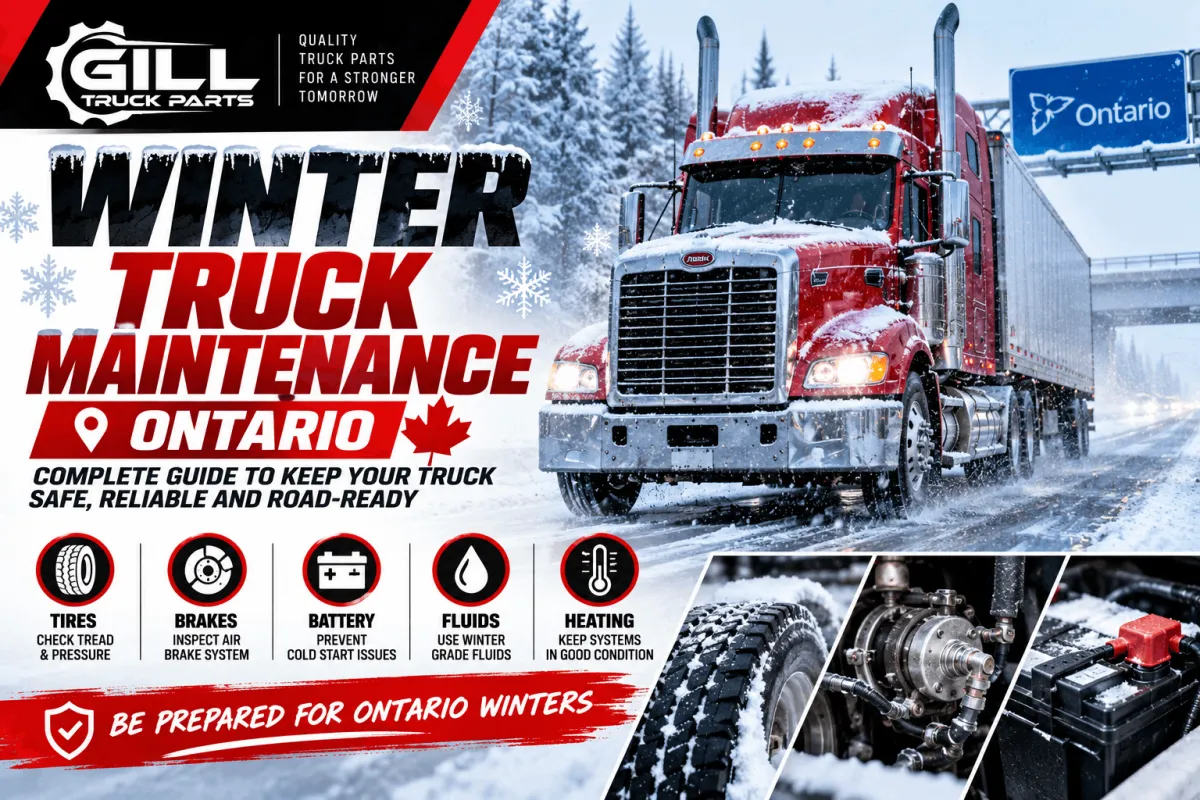
Winter Truck Maintenance Ontario: Cold-Weather Parts & Prep Checklist
Ontario winters are hard on heavy-duty trucks in ways that summer and shoulder-season driving never expose. Cold thickens fluids, drains batteries, freezes moisture in air systems, and turns marginal parts into roadside failures. The trucks that break down in January usually weren't neglected in December. They had small problems in October that nobody caught.
This checklist focuses on what changes when temperatures drop: starting, fuel, emissions fluid, electrical, and air system moisture. It doesn't try to cover every maintenance task. For general inspection routines, see our preventive maintenance guide for semi trucks, and for brake system specifics, our air brake parts guide.
Table of Contents
Why Cold Weather Causes Breakdowns
Engine Block Heaters and Cold Starts
Batteries and the Charging System
Fuel: Gelling, Filters, and Water
DEF and Emissions System Cold Issues
Air System Moisture and Freeze-Ups
Coolant, Belts, and Hoses
Lighting, Wipers, and Visibility
A Fall Prep Timeline for Fleets
Stocking Cold-Weather Parts Ahead of Time
Frequently Asked Questions
Final Thoughts
1. Why Cold Weather Causes Breakdowns
Most cold-weather failures come down to a few mechanisms:
Thicker fluids make engines harder to crank and lubricate on startup
Reduced battery output at the same time engines need more cranking power
Freezing water in fuel, air lines, and fluid tanks blocks flow
Brittle rubber and plastic in belts, hoses, and seals cracks under stress
Longer idle and warm-up times that put extra strain on components and consumables
Fall is the best time to address these, because parts are easy to source, shops aren't yet overloaded, and a scheduled repair costs far less than an emergency one in a snowstorm.
2. Engine Block Heaters and Cold Starts
An engine block heater warms coolant or engine oil so the engine is easier to start and gets lubricated faster. Cold, thick oil during cranking is one of the largest sources of engine wear, so a working heater matters beyond just convenience.
What to check:
Heater function. Plug it in and confirm it's actually heating, whether by feel, a meter, or the manufacturer's method
Power cord and plug. Look for cracked insulation, damaged prongs, or corrosion
Extension cords. Use rated, undamaged cords in good condition, since cold makes cheap cords brittle
Mounting and seals. Check for coolant seepage around the heater
Drivers' habits. Make sure they know to plug in ahead of time, following the manufacturer's guidance on duration
A failed block heater is a straightforward, inexpensive replacement in October and a serious inconvenience at 5 a.m. in January.
3. Batteries and the Charging System
Cold reduces a battery's available cranking power while the engine demands more from it. A battery that seemed fine all summer can fail the first hard cold snap.
Checklist:
Load test batteries, not just a voltage check, since a battery can show normal voltage and still fail under cranking load
Clean and tighten terminals, removing corrosion that adds resistance
Inspect cables for cracking, swelling, or corroded ends
Check the alternator output and belt condition so the charging system can keep up with winter loads (heaters, lights, defrosters)
Replace weak batteries proactively and replace them in matched sets where the truck uses multiple batteries
Batteries that are borderline in fall are the ones that leave drivers stranded, so replacing them early is usually cheaper than a tow.
4. Fuel: Gelling, Filters, and Water
Diesel fuel can thicken and wax in cold temperatures, restricting flow and clogging filters. Refiners supply winter-blend fuel to reduce this, but fleets still run into problems, particularly with fuel bought out of region, old fuel, or water contamination.
What to do:
Replace fuel filters ahead of winter so they start the season clean
Drain water from fuel/water separators regularly, since water freezes and blocks flow
Buy fuel from reliable sources and understand what blend is being supplied
Consider fuel conditioning additives if your operation calls for them, following the manufacturer's guidance
Keep tanks reasonably full to limit condensation
If a truck starts hard, loses power under load, or stalls in the cold, a restricted fuel filter is one of the first things to check.
5. DEF and Emissions System Cold Issues
Diesel exhaust fluid (DEF) freezes at roughly -11°C. Modern trucks are designed to handle this with heated DEF tanks, lines, and pumps, but those heaters and related components can fail, and a frozen or thawing DEF system can trigger derates.
Checklist:
Confirm DEF heating components work, including the tank heater and heated lines where fitted
Check DEF quality and storage. Old, contaminated, or improperly stored DEF causes problems beyond freezing
Keep DEF containers stored properly, since it shouldn't be left in extreme heat or cold for long periods
Watch for emissions warnings that appear only in cold weather, which may indicate a DEF or sensor issue
Keep DPF and aftertreatment maintenance current, since winter idling can affect regeneration
Because emissions faults can limit engine power, a DEF system problem in winter can sideline a truck even when the engine itself is fine.
6. Air System Moisture and Freeze-Ups
Compressed air always carries some moisture. In cold weather, that moisture can freeze in valves, lines, and fittings and cause brake or suspension malfunctions. This is one of the most safety-relevant winter risks on air-brake trucks.
What to check:
Air dryer condition. A failing dryer or exhausted desiccant cartridge lets moisture into the system
Air dryer heater and governor, where fitted, since they help keep it functioning in the cold
Drain air tanks regularly per your procedures to remove accumulated moisture and contaminants
Inspect air lines and fittings for leaks, which force the compressor to run more and pump more moisture through the system
Check air tanks for corrosion and condition, since moisture accelerates internal wear
Any brake system problem discovered in cold weather should be handled promptly and by a qualified technician. For brake component details, our brake drums vs. disc rotors guide explains the differences between systems.
7. Coolant, Belts, and Hoses
Cold makes rubber less flexible, so belts and hoses that were borderline in summer can crack or fail in winter.
Test coolant for freeze protection and condition, and top up with the correct mixture
Inspect belts for cracking, glazing, and correct tension, since a failed belt can cost you charging, cooling, and power steering at once
Check hoses for softness, bulges, and cracks, particularly at connections
Inspect the heater and defroster system, which drivers depend on for safe visibility
Check the radiator and cooling system for leaks or blockage
Belts and filters are among the most commonly replaced seasonal items, and they're good candidates to have on the shelf before the first cold snap.
8. Lighting, Wipers, and Visibility
Winter driving means shorter days, more precipitation, and more road spray, so visibility items matter more than usual.
Test all exterior lights and replace weak or failed bulbs and lenses
Replace worn wiper blades and check that the washer system works
Use winter-rated washer fluid, so it doesn't freeze in the lines
Clean and check mirrors, including heated mirrors where fitted
Inspect trailer lighting connections, which are prone to corrosion from road salt
9. A Fall Prep Timeline for Fleets
Timing | Focus |
|---|---|
Early fall | Load test batteries, inspect belts and hoses, test block heaters, review DEF system |
Mid fall | Replace fuel filters, service air dryers, drain air tanks, check coolant |
Before first hard freeze | Verify lighting and wipers, confirm driver procedures for plug-in and pre-trips |
Through winter | Ongoing air tank drains, fuel/water separator checks, battery and terminal checks |
Adjust this to your operation and your manufacturer's recommendations. The point is to have the work done before the weather forces the issue.
10. Stocking Cold-Weather Parts Ahead of Time
Demand for the same parts spikes when temperatures drop, and everyone tries to buy them at once. Fleets that stock or pre-order ahead usually avoid the worst of the delays.
Common cold-weather items include:
Fuel and air filters
Belts
Engine block heaters
DEF and related components
Air system components such as air tanks
Batteries, lighting, and wiper items sourced through your usual channels
Gill Truck Parts supplies filters, belts, engine heaters, DEF, and other components through our Freightliner OEM and Volvo OEM lines, along with aftermarket options for fleets across the GTA. Call ahead with your truck details and we'll confirm fitment and availability.
11. Frequently Asked Questions
When should I start winter prep for my trucks in Ontario? Early to mid fall is a good window, before the first hard freezes. It gives you time to test, replace, and reorder parts without pressure.
Do I really need a block heater? It depends on the engine, the temperatures you operate in, and whether the truck is parked outdoors overnight. Many fleets consider block heaters worth having for cold starts and reduced engine wear, and your manufacturer's guidance applies.
At what temperature does DEF freeze? DEF freezes at approximately -11°C. Modern systems include heaters to manage this, which is why those components should be verified before winter.
Why do air brake trucks have more winter problems? Moisture in compressed air can freeze in valves and lines. Keeping the air dryer functioning and draining tanks regularly reduces this risk.
What's the most common cause of no-starts in winter? Weak batteries and cold, thick oil are frequent causes, along with fuel restriction. A load test and working block heater address the first two.
Can I use the same fuel filter change interval in winter? Many fleets change filters ahead of winter to start clean, and check them more often during it. Follow your manufacturer's intervals as a baseline.
12. Final Thoughts
Cold-weather breakdowns are mostly predictable. Weak batteries, worn belts, neglected air dryers, and tired heaters are all detectable in fall with basic testing. Doing the work early, and having the parts on hand, keeps your trucks moving when conditions are at their worst and repair shops are at their busiest.
Getting Your Fleet Winter-Ready?
Gill Truck Parts has supplied heavy-duty truck parts to fleets across Mississauga and the Greater Toronto Area for over 15 years. Call us to check availability on filters, belts, block heaters, DEF, and more before the cold arrives.
📞 Call us now: 905-564-7710 📍 1295 Shawson Dr, Mississauga, ON L4W 1C4
Related reading: Preventive Maintenance Tips for Semi Trucks | Air Brake Parts for Commercial Trucks | Fleet Maintenance Parts in Mississauga