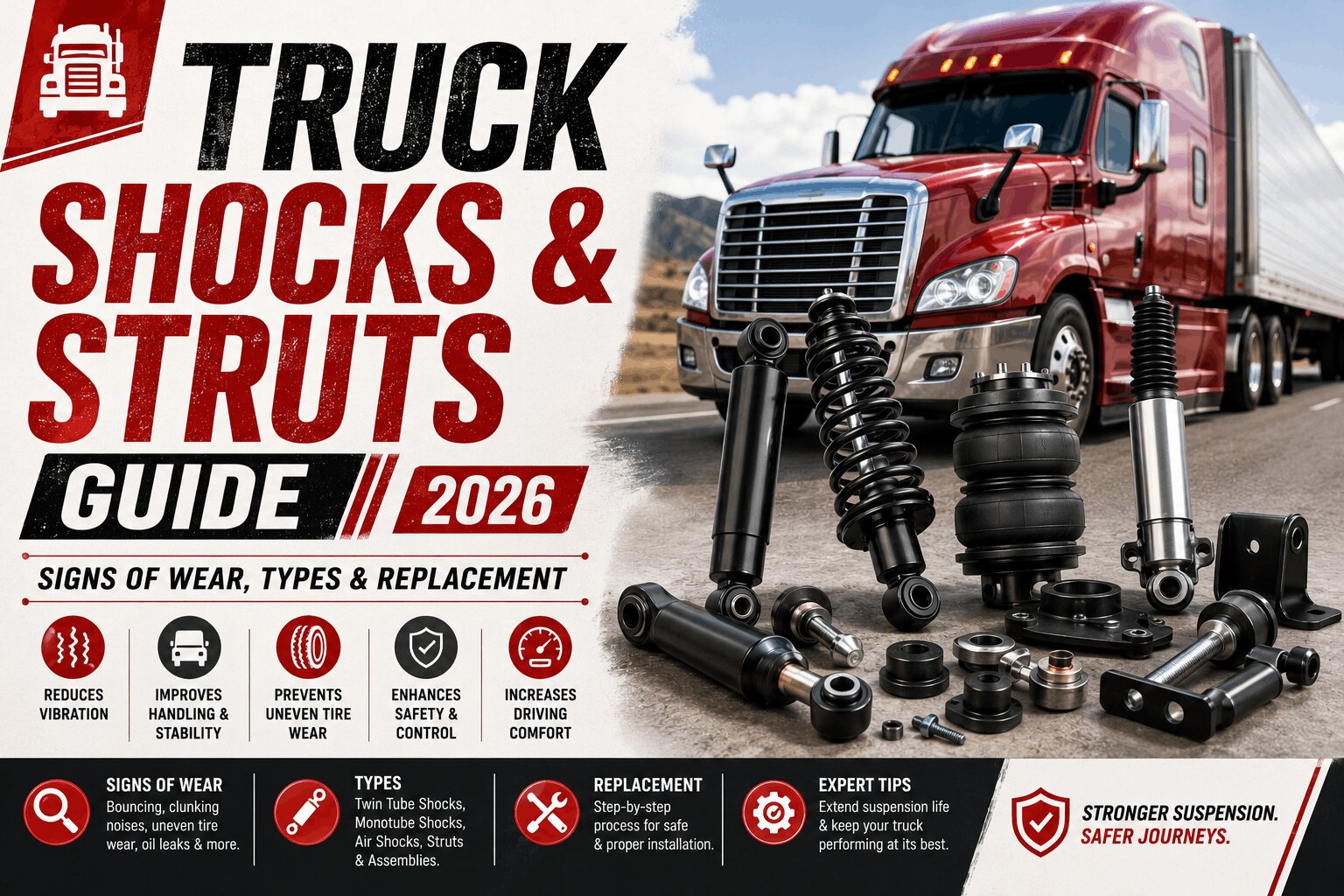
Truck Shocks & Struts Guide: Signs of Wear, Types & Replacement (2026)
Shocks and struts don't fail the way brakes or bearings do — there's rarely a sudden, dramatic breakdown. Instead, they wear gradually, and because trucks can technically still drive with worn shocks, this is one of the most commonly overlooked maintenance items in heavy-duty fleets. The problem is that worn shocks quietly compromise braking distance, tire life, cargo stability, and driver control long before anyone notices a "failure."
At Gill Truck Parts, we regularly see fleets replacing tires early, chasing alignment issues, or dealing with driver complaints about ride quality — all symptoms that trace back to worn shocks and struts. This guide covers how these components work, how to spot wear before it costs you money, and how to choose the right replacements.
Table of Contents
What Do Shocks and Struts Actually Do?
Shocks vs. Struts: What's the Difference?
Types of Heavy-Duty Truck Shocks
How Shocks Affect Braking, Tires, and Safety
Signs Your Shocks or Struts Are Worn
Common Causes of Premature Shock Wear
Inspection and Testing Methods
How Often Should Shocks Be Replaced?
How to Choose Quality Replacement Shocks
Frequently Asked Questions
Final Thoughts
1. What Do Shocks and Struts Actually Do?
Shocks and struts are damping components — their job isn't to hold up the vehicle's weight (that's the job of springs, whether leaf, coil, or air), but to control how quickly the suspension compresses and rebounds after hitting a bump, pothole, or uneven surface.
Without effective damping, a truck's springs would continue bouncing after every bump, causing the wheels to repeatedly lose and regain contact with the road. Since tire contact with the pavement is what allows a truck to steer, brake, and accelerate, shocks are fundamentally a control and safety component, not just a comfort feature.
2. Shocks vs. Struts: What's the Difference?
The terms are often used interchangeably, but there is a technical distinction:
Shock absorbers are a separate damping component, mounted alongside the spring, and don't provide structural support to the suspension.
Struts combine the shock absorber and a structural mounting point into a single unit, often bearing some of the vehicle's weight and helping locate the wheel.
On most heavy-duty commercial trucks, shock absorbers are the standard configuration, particularly paired with leaf spring or air suspension systems. True strut assemblies are more common on lighter-duty trucks and vans.
3. Types of Heavy-Duty Truck Shocks
Twin-Tube Shocks
The most common design in commercial trucking, using two nested cylinders to manage fluid flow and dissipate heat. They're durable, cost-effective, and well-suited to heavy-duty applications.
Mono-Tube Shocks
A single-cylinder design that typically offers more consistent damping performance and better heat dissipation, often used in performance or severe-duty applications where sustained heavy loads are common.
Gas-Charged Shocks
Pressurized with nitrogen gas to reduce foaming of the hydraulic fluid inside, which helps maintain consistent damping performance during extended, repetitive suspension movement — such as long highway hauls or rough terrain.
Cab Shocks
A separate but related component, cab shocks dampen the movement of the cab itself (on trucks with a suspended cab design), improving ride quality and reducing driver fatigue on long routes.
4. How Shocks Affect Braking, Tires, and Safety
This is the part fleet managers most often underestimate.
Braking distance Worn shocks allow the tires to bounce slightly during hard braking, reducing the contact patch between tire and road at the exact moment maximum grip is needed. Studies on commercial vehicle stopping distances have shown measurably longer stopping distances with worn dampers compared to new ones.
Tire wear Bouncing wheels wear unevenly, leading to cupping, scalloping, or premature tread wear — meaning worn shocks can silently be costing you tire replacement budget without anyone connecting the dots.
Steering control and stability Reduced tire contact affects steering precision and can contribute to trailer sway or reduced control during evasive maneuvers, particularly in wet or windy conditions.
Cargo and driver comfort While less safety-critical, excessive bouncing also increases wear on cargo, mounting hardware, and cab components over time, plus contributes to driver fatigue on long hauls.
5. Signs Your Shocks or Struts Are Worn
Excessive bouncing after hitting a bump, rather than settling quickly
Nose diving during braking or squatting during acceleration
Uneven or cupped tire wear patterns
Visible fluid leakage on the shock body
Clunking or knocking noises over bumps
Increased body roll during turns
Longer stopping distances than expected
Cab or mirror vibration at highway speeds
A simple "bounce test" — pushing down firmly on the corner of the truck and releasing — can offer a rough indicator: if the vehicle bounces more than once or twice before settling, the shocks may be worn.
6. Common Causes of Premature Shock Wear
Overloading beyond rated capacity, which stresses dampers beyond design limits
Consistently rough routes — job sites, gravel roads, potholed city streets
Fluid or seal leaks reducing damping fluid volume over time
Corrosion from road salt exposure, common in Ontario winters
Mounting hardware wear, including bushings that degrade and allow excess movement
Age, even with light use — rubber and seal components degrade over time regardless of mileage
7. Inspection and Testing Methods
Visual inspection for leaks, dents, corrosion, or damaged mounting hardware during every PM service
Bounce test at each corner of the vehicle
Physical shake test with the truck raised, checking for excess play in bushings and mounts
Tire wear pattern review as an indirect but reliable indicator of suspension damping issues
Road test evaluation for excessive body roll, bounce, or handling changes, particularly after any reported "rough ride" complaints from drivers
8. How Often Should Shocks Be Replaced?
There's no universal mileage figure, since wear depends heavily on route type, load, and climate exposure. However, many fleet maintenance programs build shock inspection into every major PM service interval, with replacement typically recommended proactively once wear signs appear — rather than waiting for a driver complaint or a tire wear pattern to force the issue.
Fleets running consistently rough routes (construction, waste hauling, off-highway work) should inspect more frequently than long-haul highway fleets running smoother routes.
9. How to Choose Quality Replacement Shocks
Shock quality varies significantly between manufacturers, and this is a part category where inconsistent damping performance directly affects safety. When sourcing replacements, prioritize:
Load-rated compatibility matched to your truck's GVWR and axle configuration
Gas-charged designs for applications with sustained heavy use or repetitive terrain
Corrosion-resistant coatings, especially important for salt-heavy Ontario winters
Reputable manufacturers with proven heavy-duty performance data
Matched sets — replacing shocks in axle pairs rather than one at a time helps maintain even handling characteristics
At Gill Truck Parts, we carry a full line of Shocks & Struts, Cab Shocks, and related Suspension Parts for fleets across the GTA, with fast availability to keep your trucks moving.
10. Frequently Asked Questions
Can I replace just one shock instead of the pair? It's generally not recommended. Mismatched shocks (one worn, one new) can cause uneven handling and damping performance, so most technicians recommend replacing shocks in axle pairs.
How do I know if it's my shocks or my springs? Springs handle weight support and ride height, while shocks control bounce and rebound. If the truck sits noticeably lower or leans to one side, that points to springs; if it bounces excessively after bumps, that points to shocks.
Do worn shocks affect braking distance? Yes — reduced tire contact during braking, caused by worn dampers, can measurably increase stopping distance, which is why shocks are considered a safety-related component, not just a comfort item.
How long do heavy-duty truck shocks typically last? This varies widely by route type and load, which is why most fleets rely on inspection-based replacement (checking for wear signs) rather than a fixed mileage interval.
Are gas-charged shocks worth the extra cost over standard hydraulic shocks? For trucks running sustained heavy use, rough terrain, or long highway hauls, gas-charged shocks often provide more consistent performance over time, which can justify the higher upfront cost.
11. Final Thoughts
Shocks and struts rarely announce their failure the way a brake or bearing issue does — but their impact on braking distance, tire wear, and vehicle control makes them just as important to a fleet's safety and cost management. Building shock inspection into your regular PM schedule, watching for the warning signs above, and choosing properly rated replacement parts will save money on tires, reduce driver fatigue, and keep stopping distances where they need to be.
Need Shocks, Struts, or Suspension Parts for Your Fleet?
Gill Truck Parts has supplied heavy-duty truck parts to fleets across Mississauga and the Greater Toronto Area for over 15 years. Our team can help you find the right suspension components fast, backed by trusted brands.
📞 Call us now: 905-564-7710 📍 1295 Shawson Dr, Mississauga, ON L4W 1C4
Related reading: 5 Signs Your Heavy-Duty Truck Suspension Needs Immediate Attention | Truck Wheel Bearings: The Complete Guide | Brake Drums vs. Disc Rotors: The Complete Guide