




Blog
Stay Informed With Expert Auto Tips & Insights
We’re dedicated to providing you with the latest automotive news, maintenance tips, and expert advice. Our blog is your go-to resource for everything from vehicle care to understanding common issues and how to prevent them.
Mastery.
Proficiency.
Creativity.
Revolution.
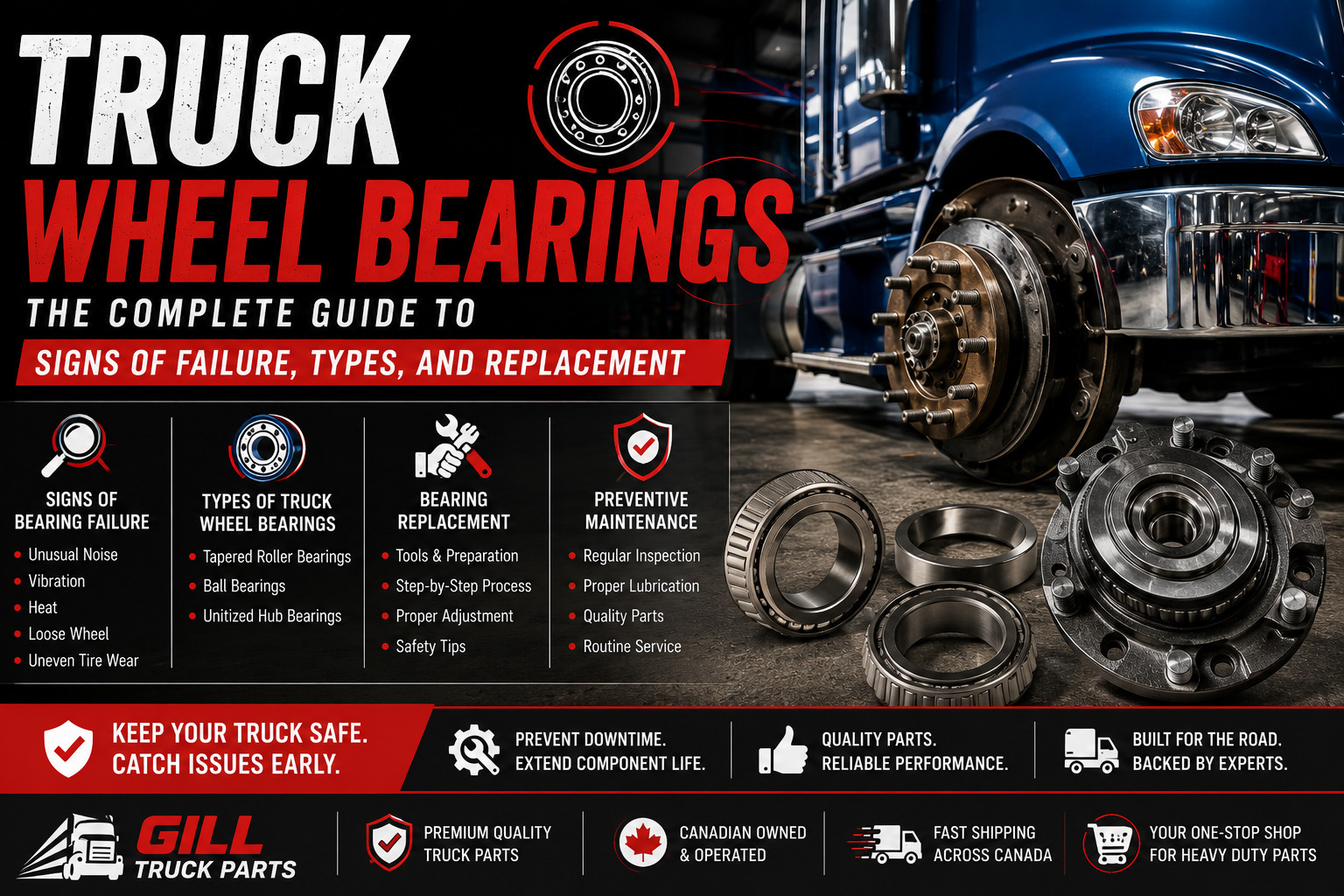
Truck Wheel Bearings: The Complete Guide to Signs of Failure, Types, and Replacement
Wheel bearings don't get the attention that brakes or suspension parts do, but they're one of the most safety-critical components on any heavy-duty truck. A failed wheel bearing can cause a wheel to overheat, seize, or in worst-case scenarios, separate from the vehicle entirely while it's moving. Yet because bearing wear happens gradually and often quietly, it's one of the most commonly neglected maintenance items in commercial fleets.
At Gill Truck Parts, we see the same story again and again: a fleet manager brings in a truck for an unrelated repair, and a technician catches a wheel bearing that was days away from catastrophic failure. This guide covers everything you need to know about heavy-duty truck wheel bearings — what they do, how to spot failure early, the different types available, and how to choose the right replacement.
Table of Contents
What Do Wheel Bearings Do?
Types of Truck Wheel Bearings
Common Causes of Wheel Bearing Failure
Warning Signs of a Failing Wheel Bearing
Why Wheel Bearing Failure Is So Dangerous
Inspection and Maintenance Best Practices
Wheel Bearing Replacement: What to Expect
Hub-Piloted vs. Unitized Hub Assemblies
How to Choose Quality Replacement Bearings
Frequently Asked Questions
Final Thoughts
1. What Do Wheel Bearings Do?
Wheel bearings sit inside the hub assembly, allowing the wheel to rotate smoothly around the axle spindle while supporting the full weight of the vehicle and its load. They're engineered to handle constant radial and axial loads — meaning they absorb both the downward weight of the truck and the side-to-side forces created by cornering, braking, and uneven road surfaces.
On a heavy-duty truck, wheel bearings typically work in pairs (inner and outer) within each hub, packed with grease or oil to reduce friction and dissipate heat generated by constant rotation under load.
Because they're constantly under stress, wheel bearings are considered a wear item — not a "lifetime" component — and require regular inspection as part of any preventive maintenance program.
2. Types of Truck Wheel Bearings
Tapered Roller Bearings
The traditional standard in heavy-duty trucking. These use cone-shaped rollers arranged to handle both radial and thrust loads, and they're typically serviced (and re-greased) periodically as part of routine maintenance.
Unitized (Pre-Set) Hub Bearings
Increasingly common on newer trucks and trailers, unitized hub assemblies come pre-set and sealed from the factory, combining the bearing, seal, and sometimes the hub itself into a single cartridge unit. These reduce the risk of improper bearing adjustment (a common cause of premature failure) and often require less field maintenance.
Wheel-End Sensor-Integrated Bearings
Some newer commercial trucks use hub assemblies with integrated ABS sensors or telematics-ready components, allowing fleets to monitor wheel-end health in real time — a growing trend as fleets adopt predictive maintenance technology.
3. Common Causes of Wheel Bearing Failure
Understanding why bearings fail helps prevent it. The most common causes include:
Improper installation or adjustment — over-tightened or under-tightened bearings wear unevenly and fail faster
Contamination — dirt, water, or road debris entering the hub due to a damaged seal
Lack of lubrication — insufficient or degraded grease leads to excess friction and heat
Overloading — consistently exceeding axle weight ratings accelerates wear
Impact damage — hitting potholes, curbs, or debris at speed
Normal wear over time — even well-maintained bearings eventually reach end of service life
4. Warning Signs of a Failing Wheel Bearing
Catching these symptoms early can prevent a roadside breakdown — or worse.
Unusual noise A humming, growling, or grinding sound that changes with vehicle speed (and sometimes gets quieter when turning one direction) is one of the most common and telling signs of bearing wear.
Vibration A failing bearing often causes a noticeable vibration through the steering wheel or cab floor, especially at highway speeds.
Wheel wobble or play When a truck is safely lifted, a technician can check for excess play by grabbing the tire at the 12 and 6 o'clock positions and rocking it. Noticeable movement indicates bearing wear.
Uneven or excessive tire wear Because a worn bearing allows slight wheel misalignment, it can cause abnormal tire wear patterns that show up before more obvious symptoms appear.
Burning smell or overheating hub A hub that's hot to the touch — hotter than the others — often signals excess friction from a failing bearing.
ABS warning light On trucks with ABS sensors integrated into the hub assembly, bearing wear can disrupt sensor readings and trigger a dashboard warning.
5. Why Wheel Bearing Failure Is So Dangerous
Unlike a slow brake pad wear-down, wheel bearing failure can escalate quickly. As a bearing degrades, friction and heat increase, which accelerates wear even further — creating a compounding failure cycle. Left unaddressed, this can lead to:
Complete bearing seizure, locking the wheel and causing loss of control
Wheel separation from the vehicle while in motion
Hub fires caused by extreme friction-generated heat
Extensive damage to the spindle, axle, and surrounding components — turning a relatively inexpensive repair into a major one
This is why wheel bearing inspection is a required checkpoint in most commercial vehicle safety inspections, and why fleets should never treat early warning signs as something to "monitor" rather than fix.
6. Inspection and Maintenance Best Practices
Include wheel bearings in every scheduled PM inspection, not just annual safety checks
Check grease color and consistency — milky or gritty grease indicates water contamination or debris intrusion
Monitor hub temperature during and after routes, especially for long-haul trucks
Inspect seals for cracking, tearing, or leakage during every brake service (since brakes and bearings are serviced together)
Follow torque specifications exactly during any bearing adjustment or reinstall — improper torque is one of the leading causes of premature failure
Track bearing service history per axle/wheel position so patterns of recurring failure can be caught early
7. Wheel Bearing Replacement: What to Expect
A typical wheel bearing replacement involves:
Removing the wheel and brake components to access the hub
Removing the hub assembly and inspecting the spindle for damage or scoring
Removing old bearings, seals, and races
Cleaning and inspecting the hub cavity
Installing new bearings, races, and seals
Packing with the correct grease (or using a pre-set unitized unit)
Torquing to manufacturer specification
Reassembling brakes and wheel, then verifying proper rotation and play
Labor time varies depending on whether the truck uses conventional tapered bearings or a unitized hub assembly, with unitized systems generally offering faster, more consistent installation.
8. Hub-Piloted vs. Unitized Hub Assemblies
Feature Conventional (Hub-Piloted) Unitized Hub Assembly Installation Complexity Higher — requires manual bearing adjustment Lower — comes pre-set Risk of Improper Adjustment Higher Minimal Maintenance Requires periodic re-greasing Often sealed, less frequent service Upfront Cost Lower Higher Common Applications Older fleets, some trailers Newer trucks, many trailer OEM specs
Many fleets are transitioning toward unitized hub assemblies specifically because they reduce the risk of technician error during installation — a major contributing factor in premature bearing failure.
9. How to Choose Quality Replacement Bearings
Not all wheel bearings are manufactured to the same tolerances, and this is a part where quality directly affects safety. When sourcing replacements, look for:
Precision-manufactured tapered rollers and races with tight tolerance control
Sealed units with quality nitrile or PTFE seals resistant to water and contaminant intrusion
Compatibility verification with your specific axle, hub, and OEM specifications
Reputable brands with proven heavy-duty duty-cycle performance
A supplier that stocks matched sets (bearing, race, and seal), since mixing components from different sources can affect fit and performance
At Gill Truck Parts, we carry a full range of Wheel Bearings, Hub Assemblies, and Wheel Seals for fleets across the GTA, with fast turnaround so your trucks spend less time in the shop.
10. Frequently Asked Questions
How long do truck wheel bearings last? Service life varies widely based on load, route type, and maintenance quality, but many heavy-duty bearings are inspected and re-greased on a scheduled interval and replaced proactively before reaching failure, rather than run to breakdown.
Can I drive with a bad wheel bearing? It's not recommended. A failing bearing can progress from noise and vibration to complete failure relatively quickly, and continuing to drive increases the risk of wheel separation or hub damage.
What does a bad wheel bearing sound like? Most commonly a humming or growling noise that increases with speed, sometimes accompanied by grinding if the bearing has significantly deteriorated.
Are unitized hub bearings worth the extra cost? For many fleets, yes — the reduced risk of improper installation and lower long-term maintenance labor often offsets the higher upfront part cost, especially for high-mileage trucks.
How often should wheel bearings be inspected? Most fleets check wheel bearings at every brake service interval and during scheduled preventive maintenance, in addition to any required annual safety inspections.
11. Final Thoughts
Wheel bearings may be a small, hidden component compared to brakes or suspension parts, but their failure carries some of the highest safety risk on a commercial truck. Regular inspection, proper installation, and using quality replacement parts are the best defenses against unexpected downtime — or worse, a roadside incident.
Whether you're running conventional tapered bearings or upgrading to unitized hub assemblies, staying ahead of wear is always cheaper and safer than reacting to failure.
Need Wheel Bearings or Hub Assemblies for Your Fleet?
Gill Truck Parts has supplied heavy-duty truck parts to fleets across Mississauga and the Greater Toronto Area for over 15 years. Our team can help you find the right wheel-end components fast, backed by trusted brands.
📞 Call us now: 905-564-7710 📍 1295 Shawson Dr, Mississauga, ON L4W 1C4
Related reading: Air Brake Parts for Commercial Trucks: The Complete Guide | Brake Drums vs. Disc Rotors: The Complete Guide | 5 Signs Your Heavy-Duty Truck Suspension Needs Immediate Attention
Need Reliable Truck Parts? Get Expert Help Fast
Need dependable heavy duty truck parts in Mississauga or the GTA? Our experts help you quickly find the right components for your truck, reducing downtime and keeping your fleet running safely and efficiently.
Reliable distributor of heavy-duty truck parts in Mississauga, proudly serving the 401 Dixie corridor and the Greater Toronto Area.
Our Partner
Service Area
Contact us
1295 Shawson Dr, Mississauga, ON L4W 1C4

© 2026 Gill Truck Parts. All rights reserved. Powered by Xalovo AI