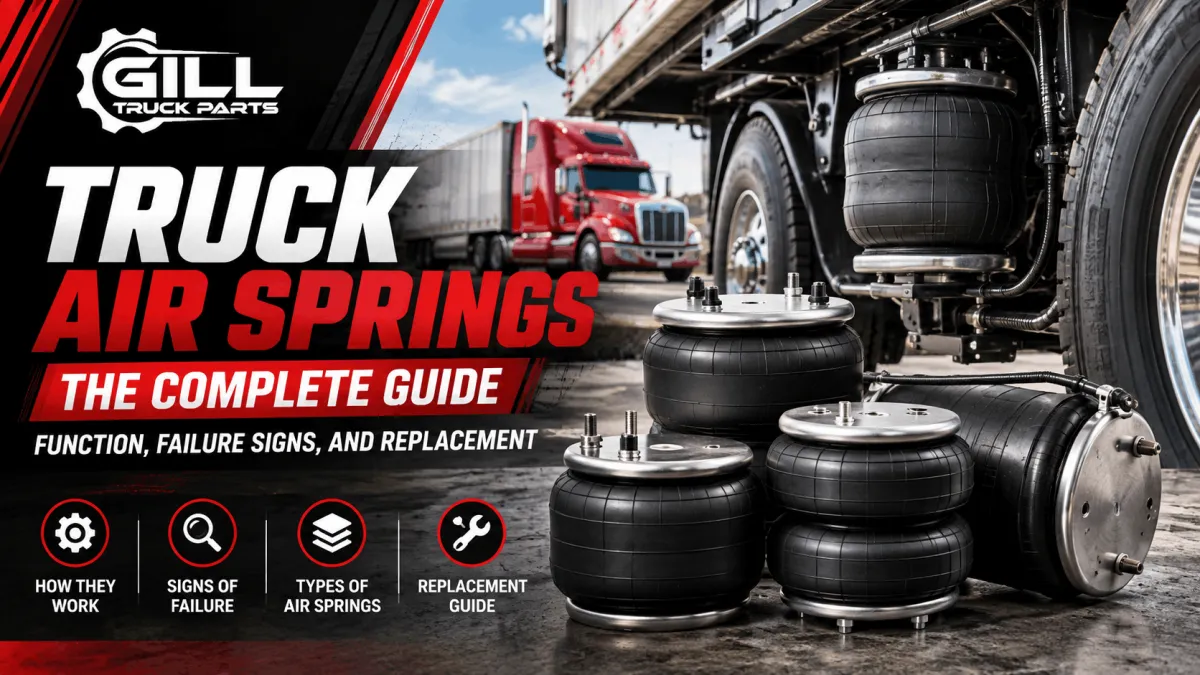
Truck Air Springs: The Complete Guide to Function, Failure Signs, and Replacement
Air suspension has become the standard on most modern heavy-duty trucks and trailers, replacing traditional leaf springs on a growing share of new equipment. At the center of that system sits the air spring — sometimes called an air bag — a component that looks simple from the outside but plays a critical role in ride quality, load stability, and even cargo protection.
Because air springs are made of reinforced rubber rather than steel, they wear differently than the suspension components fleets are used to inspecting. At Gill Truck Parts, we regularly see air springs that failed suddenly after showing subtle warning signs for weeks — a truck sitting slightly lower on one corner, a faint hissing sound, a bit more body roll in turns. This guide covers how air springs work, what to watch for, and how to choose the right replacement.
Table of Contents
What Is a Truck Air Spring?
How Air Ride Suspension Works
Air Springs vs. Leaf Springs
Types of Truck Air Springs
Signs of a Failing Air Spring
Common Causes of Air Spring Failure
Why Air Spring Failure Shouldn't Be Ignored
Inspection and Maintenance Best Practices
How to Choose Quality Replacement Air Springs
Frequently Asked Questions
Final Thoughts
1. What Is a Truck Air Spring?
An air spring is a flexible, air-filled rubber bellows that sits between the axle and the truck's frame, supporting the vehicle's weight using compressed air instead of a solid steel spring. As air pressure inside the bellows changes, it adjusts how much support the suspension provides — allowing the system to automatically compensate for changes in load.
This is the key advantage over traditional leaf springs: an air spring can maintain a consistent, level ride height whether the trailer is empty or fully loaded, whereas a leaf spring's support level is fixed by its physical design.
2. How Air Ride Suspension Works
A complete air ride suspension system includes several components working together:
Air springs — the flexible bellows that support vehicle weight
Height control valves — sense ride height and add or release air to maintain the correct level
Air lines and fittings — deliver compressed air from the truck's air system to each spring
Air compressor and reservoir — supply the compressed air the system relies on
As load changes (empty vs. loaded trailer, uneven weight distribution), the height control valve automatically adjusts air pressure in each spring, keeping the frame at a consistent height and distributing weight evenly across the axles.
3. Air Springs vs. Leaf Springs
Feature | Air Springs | Leaf Springs |
|---|---|---|
Ride Quality | Smoother, adjusts to load | Firmer, fixed response |
Load Leveling | Automatic | Not adjustable |
Cargo Protection | Better vibration dampening | More vibration transmitted |
Maintenance | Air system components require inspection | Simpler, fewer components |
Upfront Cost | Higher | Lower |
Common Failure Mode | Punctures, dry rot, air leaks | Cracking, sagging |
Best For | Freight-sensitive loads, driver comfort | Heavy, rugged, off-highway applications |
Many fleets use air springs on the trailer and drive axle for ride quality and cargo protection, while sticking with leaf springs in rougher-duty applications where puncture risk from debris is a greater concern.
4. Types of Truck Air Springs
Sleeve-Type (Rolling Lobe) Air Springs
The most common design, using a flexible rubber sleeve that rolls along a piston as it compresses and extends. These offer smooth, progressive support and are widely used across trailers and drive axles.
Convoluted (Bellows) Air Springs
Featuring one or more fixed convolutions (folds) rather than a rolling sleeve, these are often used in applications requiring more consistent spring rate across a range of heights, such as certain cab suspension systems.
Reversible Sleeve Air Springs
Designed for tighter packaging where a standard rolling lobe design won't fit, commonly seen in certain trailer and specialty vehicle applications.
5. Signs of a Failing Air Spring
Uneven ride height One corner of the truck or trailer sitting noticeably lower than the others is one of the clearest signs of an air spring leak or failure.
Hissing or whistling sounds Air escaping from a punctured or cracked air spring often produces an audible hissing sound, particularly noticeable when the vehicle is stationary.
Increased body roll or bounce A failing air spring loses its ability to properly support and dampen movement, leading to more noticeable sway during turns or bouncing over bumps.
Compressor running more frequently If the onboard air system's compressor cycles more often than normal, it may be working overtime to compensate for a slow leak somewhere in the air spring or its fittings.
Visible cracking, bulging, or dry rot Since air springs are made of reinforced rubber, they're susceptible to UV exposure, ozone exposure, and age-related deterioration — visible cracking or bulging along the sidewall is a clear warning sign.
Rubbing or contact marks Signs of the air spring rubbing against nearby components can indicate it's not maintaining proper ride height, risking further damage.
6. Common Causes of Air Spring Failure
Road debris punctures — rocks, metal debris, or sharp road hazards striking the exposed bellows
UV and ozone exposure — rubber degrades over time from sun exposure and atmospheric ozone, especially with heavy outdoor storage
Overextension or overcompression — operating outside the air spring's designed height range
Contaminated air supply — moisture or oil in the truck's air system can accelerate internal degradation
Age — even with proper care, rubber air springs have a finite service life and should be evaluated for replacement as they age, regardless of visible damage
Height control valve malfunction — a faulty valve can cause over-inflation or under-inflation, stressing the air spring beyond its intended range
7. Why Air Spring Failure Shouldn't Be Ignored
Unlike a slow leak in a tire, a failing air spring affects more than just ride comfort:
Cargo damage risk — sensitive freight (electronics, food products, fragile goods) is more susceptible to damage when suspension dampening is compromised
Uneven weight distribution — a sagging corner shifts weight distribution across axles, which can affect braking balance and tire wear
Sudden deflation risk — a punctured air spring can lose all pressure quickly, causing a sudden drop on that corner while the vehicle is in motion
Frame or component contact damage — a fully deflated air spring can allow metal-to-metal contact between the axle and frame, causing more expensive damage beyond the air spring itself
8. Inspection and Maintenance Best Practices
Visual inspection at every PM service — check for cracking, bulging, or visible wear along the entire circumference of the air spring
Check ride height at all four corners — uneven height is often the earliest detectable sign of a developing issue
Listen for air leaks — during a walk-around inspection, particularly around air spring fittings and connections
Inspect height control valve linkages — ensure they move freely and aren't bent or disconnected
Avoid pressure washing directly at close range — high-pressure water can accelerate wear on rubber air spring surfaces over time
Track air spring age, not just visible condition, since rubber degrades even without obvious damage
9. How to Choose Quality Replacement Air Springs
Air spring quality varies significantly, and a failure while in service can cause more than just an inconvenient breakdown. When sourcing replacements, prioritize:
OEM-matched fitment — verifying the correct bead plate configuration, height range, and mounting style for your specific axle and suspension setup
Reinforced, multi-ply rubber construction designed for heavy-duty duty cycles
UV and ozone-resistant compounds to extend service life in outdoor operating conditions
Reputable manufacturers with proven heavy-duty performance history
Matched pairs — replacing air springs on the same axle together helps maintain even ride height and load distribution
At Gill Truck Parts, we stock a full range of Air Springs, Air Tanks, and related Suspension Parts for fleets across the GTA, with fast availability to minimize downtime.
10. Frequently Asked Questions
How long do truck air springs typically last? Service life varies based on operating conditions, UV exposure, and mileage, which is why many fleets inspect air springs regularly rather than relying on a fixed replacement interval.
Can I drive with a leaking air spring? It's not recommended for extended periods — a leaking air spring can fail suddenly, cause uneven weight distribution, and risk metal-to-metal contact between the axle and frame if it fully deflates.
Are air springs better than leaf springs for cargo protection? Generally yes — air springs provide smoother, more consistent dampening, which reduces vibration transmitted to freight, making them a common choice for freight-sensitive hauling.
What causes an air spring to crack? UV exposure, ozone exposure, age, and operating outside the designed height range are the most common causes of cracking and dry rot in air spring rubber.
Should I replace air springs in pairs? Yes, most technicians recommend replacing air springs on the same axle together to maintain even ride height and consistent load distribution across the suspension.
11. Final Thoughts
Air springs are one of the more overlooked components in a modern air ride suspension system, largely because their gradual wear doesn't always announce itself the way a mechanical part failure does. Watching for uneven ride height, hissing sounds, and visible rubber deterioration — and replacing air springs proactively as they age — helps protect cargo, maintain even weight distribution, and avoid a sudden failure on the road.
Need Air Springs or Suspension Parts for Your Fleet?
Gill Truck Parts has supplied heavy-duty truck parts to fleets across Mississauga and the Greater Toronto Area for over 15 years. Our team can help you find the right air ride suspension components fast, backed by trusted brands like Dayton Parts.
📞 Call us now: 905-564-7710 📍 1295 Shawson Dr, Mississauga, ON L4W 1C4
Related reading: Truck Shocks and Struts: The Complete Guide | 5 Signs Your Heavy-Duty Truck Suspension Needs Immediate Attention | Truck Wheel Bearings: The Complete Guide