Brake Drums vs. Disc Rotors for Trucks (Complete Guide)
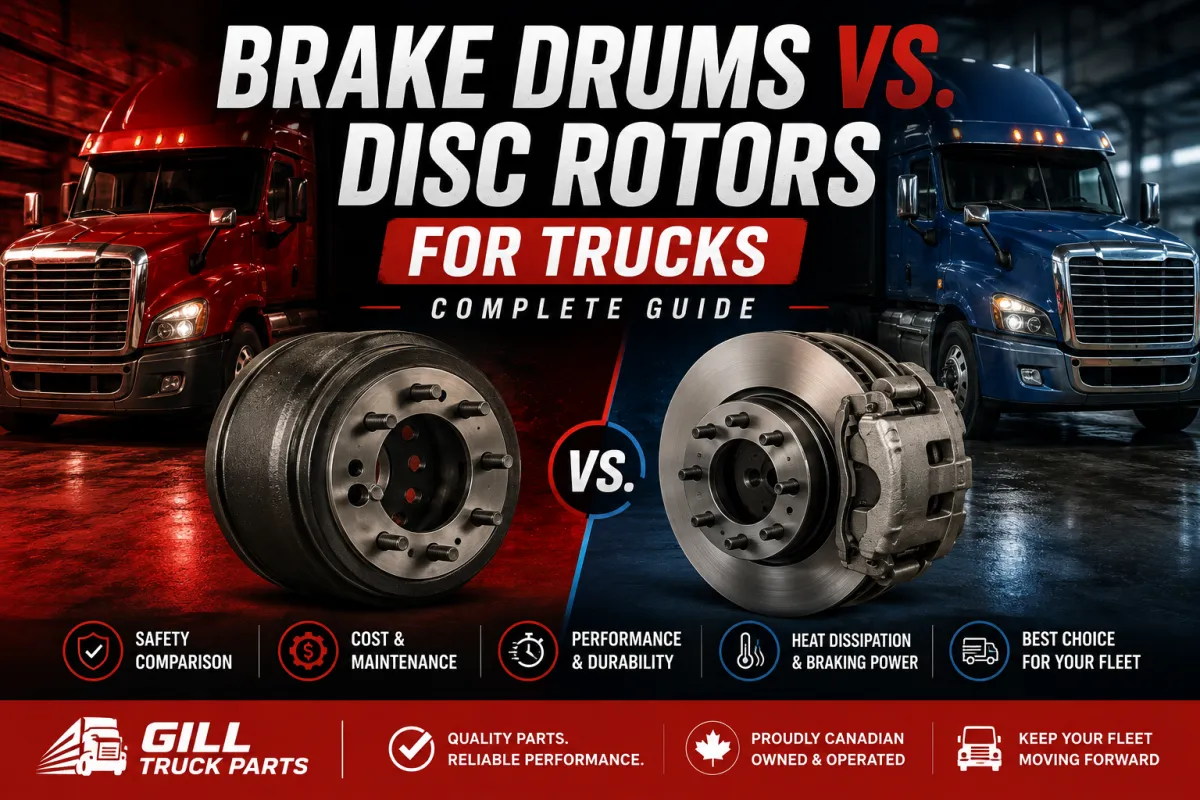
Brake Drums vs. Disc Rotors for Trucks: The Complete Guide to Choosing the Right Braking System
Braking performance is one of the most critical safety factors for any commercial vehicle. Whether you're running a single rig or managing a fleet of dozens of trucks across the GTA, the choice between drum brakes and disc rotors directly affects stopping distance, maintenance costs, downtime, and long-term reliability.
At Gill Truck Parts, we get asked this question almost every week: "Should I stick with drum brakes or upgrade to disc rotors?" The honest answer is — it depends on your application, your budget, and how your trucks are used day to day.
This guide breaks down everything fleet managers and owner-operators need to know about brake drums vs. disc rotors for heavy-duty trucks, so you can make an informed decision and keep your vehicles safe, compliant, and on the road.
Table of Contents
How Truck Braking Systems Work
What Are Brake Drums?
What Are Disc Rotors?
Brake Drums vs. Disc Rotors: Key Differences
Performance Comparison
Cost Comparison: Upfront vs. Lifetime
Maintenance Requirements
Which System Is Better for Your Fleet?
Signs Your Brake Drums or Rotors Need Replacement
How to Choose Reliable Replacement Parts
Frequently Asked Questions
Final Thoughts
1. How Truck Braking Systems Work
Before comparing the two systems, it helps to understand the basics of how heavy-duty truck brakes function.
Most commercial trucks in North America use air brake systems, which rely on compressed air (rather than hydraulic fluid, as in passenger vehicles) to apply braking force. When the driver presses the brake pedal, air pressure is released through a network of chambers, valves, and lines, activating either:
Drum brakes — where brake shoes press outward against the inside of a rotating drum, or
Disc brakes — where a caliper squeezes brake pads against a flat rotor attached to the wheel hub.
Both systems are designed to convert kinetic energy into heat through friction, slowing the vehicle safely. The system you choose affects how efficiently that heat is dissipated, how consistent your stopping power is, and how much maintenance your fleet requires.
2. What Are Brake Drums?
Drum brakes have been the standard in heavy-duty trucking for decades, and for good reason — they're durable, cost-effective, and well understood by technicians across North America.
Key components of a drum brake system:
Brake drum — the rotating metal cylinder attached to the wheel
Brake shoes — curved friction linings that press against the inside of the drum
S-cam — rotates to push the shoes outward
Return springs — retract the shoes when braking stops
Slack adjusters — maintain proper shoe-to-drum clearance
Drum brakes remain extremely common on trailers and rear axles of tractor-trailers, largely because of their lower upfront cost and ability to handle sustained heavy loads without overheating as quickly in certain applications.
3. What Are Disc Rotors?
Air disc brakes (ADB) have grown rapidly in popularity over the last decade, especially on steer axles and increasingly on drive axles as well.
Key components of a disc brake system:
Rotor — a flat, vented metal disc that spins with the wheel
Caliper — houses the brake pads and clamps them onto the rotor
Brake pads — friction material that contacts the rotor
Air chamber — converts air pressure into clamping force
Disc rotors offer more consistent, shorter stopping distances, especially in wet or emergency braking conditions — a major reason why the FMCSA and safety advocates have pushed for broader adoption across the industry.
4. Brake Drums vs. Disc Rotors: Key Differences
5. Performance Comparison
Stopping Power
This is where disc rotors have a clear advantage. Independent testing by organizations like the FMCSA has shown that trucks equipped with air disc brakes can stop 20–30% faster than those with drum brakes, particularly in emergency braking scenarios at highway speeds. That difference can mean the gap between a safe stop and a collision.
Heat Management
Drum brakes are enclosed, which traps heat during repeated or prolonged braking — common in mountainous routes or stop-and-go city driving. This can lead to brake fade, a temporary loss of stopping power. Disc rotors are exposed to open air, allowing heat to dissipate far more efficiently, which reduces fade risk on long descents or heavy-load routes.
Wet and Cold Weather Performance
Since Ontario fleets deal with everything from summer heat to icy winters, this matters. Drum brakes can trap water and debris inside the drum, delaying full braking engagement in wet conditions. Disc brakes shed water more effectively and maintain more consistent bite, which is a meaningful safety advantage during GTA winters.
6. Cost Comparison: Upfront vs. Lifetime
Cost is often the deciding factor for fleet managers, so let's break it down honestly.
Upfront Costs Drum brake systems are generally less expensive to purchase and install, both in terms of parts and labor. This is one reason many trailers still ship standard with drum brakes.
Lifetime Costs Here's where it gets more nuanced. While disc brake pads may need replacement more frequently than drum linings, the labor to replace them is often faster and cheaper per service, since technicians don't need to disassemble as many components. Drum brake service, by contrast, involves more parts (springs, adjusters, cams) that can wear out and add to long-term costs.
Downtime Costs Faster service times for disc brakes can also mean less vehicle downtime — a critical factor for fleets trying to maximize on-road hours and minimize lost revenue.
Bottom line: Drums win on upfront cost. Discs often win on lifetime cost and uptime, depending on your duty cycle and route type.
7. Maintenance Requirements
Drum Brake Maintenance
Regular inspection of brake shoe lining thickness
Checking and adjusting slack adjusters (especially with older manual-adjust systems)
Inspecting return springs and hardware for wear
Monitoring for drum cracking, scoring, or out-of-round wear
Lubricating S-cam bushings periodically
Disc Rotor Maintenance
Monitoring pad wear (often via built-in wear indicators)
Inspecting rotor thickness and surface condition
Checking caliper slide pins and guide bolts for smooth movement
Verifying air chamber function and seals
Generally, disc brake systems require more frequent visual checks but less labor-intensive repairs, while drum systems require less frequent but more involved service when components do wear out.
8. Which System Is Better for Your Fleet?
There's no universal answer — it depends on your specific operation.
Drum brakes may be the better fit if:
You operate primarily on flat, highway routes with predictable braking patterns
Your budget prioritizes lower upfront equipment costs
Your trailers are already spec'd with drum systems and switching isn't cost-effective
You run heavier, sustained loads where drum durability has historically performed well
Disc rotors may be the better fit if:
Safety and stopping distance are top priorities (especially for steer axles)
You operate in hilly terrain, urban stop-and-go traffic, or winter conditions
You want to reduce vehicle downtime with faster service intervals
You're already required to meet newer OEM specs, since many new tractors ship with disc brakes standard on steer axles
Many fleets today run a hybrid setup — disc brakes on the steer axle for maximum control, and drum brakes on trailer axles for cost efficiency. This is increasingly common across Ontario fleets and is worth discussing with your parts supplier or fleet maintenance provider.
9. Signs Your Brake Drums or Rotors Need Replacement
Regardless of which system your trucks use, watch for these warning signs:
Pulling to one side when braking
Vibration or shuddering through the brake pedal or steering wheel
Squealing, grinding, or scraping noises
Increased stopping distance
Visible scoring, cracking, or heat spots on drums or rotors
Uneven lining or pad wear
Dashboard air pressure or brake warning lights
Catching these signs early prevents more expensive repairs and, more importantly, keeps your drivers and other road users safe.
10. How to Choose Reliable Replacement Parts
Not all brake components are built to the same standard, and this is one area where cutting corners can be costly — both financially and in terms of safety liability.
When sourcing brake drums, rotors, or related components, look for:
DOT and FMVSS compliance for all safety-critical parts
OEM-matched specifications for fit and performance
Reputable manufacturers with proven heavy-duty track records
Consistent supply availability, so a single part failure doesn't sideline your truck for days
A supplier who understands fleet turnaround needs, not just retail counter sales
At Gill Truck Parts, we stock a wide range of Brake Drums, Disc Rotors, Air Disc Pads, and Brake Wheel Kits, backed by trusted brands and fast access for fleets across the GTA.
11. Frequently Asked Questions
Are disc brakes required on all new commercial trucks? Not universally, but many OEMs now ship steer axles with air disc brakes as standard due to safety and performance advantages, and adoption continues to grow across the industry.
Can I mix drum and disc brakes on the same truck? Yes — many fleets use disc brakes on the steer axle and drum brakes on trailer axles. This is a common and accepted configuration.
How often should truck brakes be inspected? Federal and provincial regulations require periodic inspections, but most fleets check brake components at every scheduled maintenance interval, typically every 15,000–25,000 km depending on duty cycle.
Do disc brakes really stop faster than drum brakes? Yes, testing consistently shows air disc brakes reduce stopping distance compared to drum brakes, particularly in emergency and wet-weather braking scenarios.
Which brake system costs less over the life of the truck? It depends on route type and duty cycle, but many fleets find disc brakes reduce lifetime costs through lower labor time per service and reduced downtime, even though pad replacement is more frequent.
12. Final Thoughts
Choosing between brake drums and disc rotors isn't about which system is universally "better" — it's about matching the right braking technology to your fleet's routes, load types, budget, and safety priorities. Drum brakes remain a reliable, cost-effective choice for many trailer applications, while disc rotors offer measurable safety and performance advantages that are increasingly becoming the industry standard, especially on steer axles.
Whatever system your fleet runs, the key to safe, reliable braking is using quality, properly specified replacement parts and staying ahead of maintenance — not catching up after a failure.
Need Help Choosing the Right Brake Parts for Your Fleet?
Gill Truck Parts has been supplying heavy-duty truck parts to fleets across Mississauga and the Greater Toronto Area for over 15 years. Whether you need brake drums, disc rotors, or a full brake system overhaul, our team can help you find the right parts fast.
📞 Call us now: 905-564-7710 📍 1295 Shawson Dr, Mississauga, ON L4W 1C4
Related reading: Air Brake Parts for Commercial Trucks: The Complete Guide | Preventive Maintenance Tips for Semi Trucks