




Blog
Stay Informed With Expert Auto Tips & Insights
We’re dedicated to providing you with the latest automotive news, maintenance tips, and expert advice. Our blog is your go-to resource for everything from vehicle care to understanding common issues and how to prevent them.
Mastery.
Proficiency.
Creativity.
Revolution.
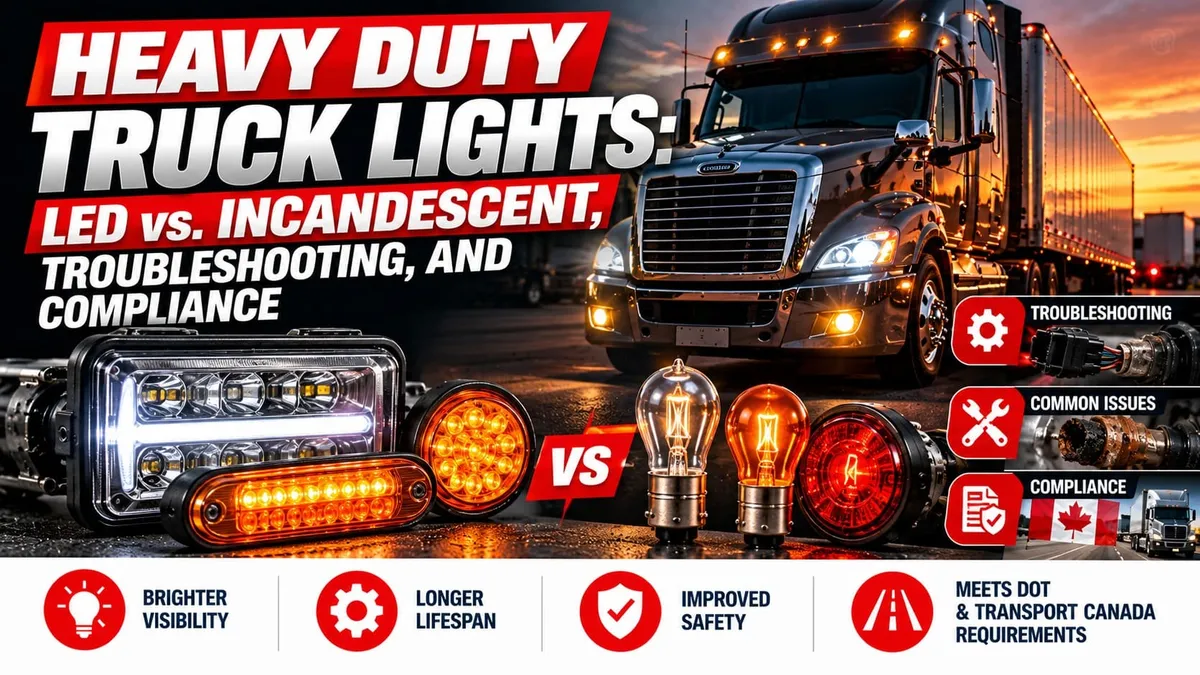
Heavy Duty Truck Lights: LED vs. Incandescent, Troubleshooting, and Compliance
Truck lighting rarely gets much thought until a light goes out, and then it gets a lot. A failed marker light or brake lamp can mean a roadside inspection stop, a ticket, or an out-of-service order, and at night it's a genuine safety risk. Lighting faults are also notoriously annoying to diagnose, because the symptom (a dead or flickering light) is often far from the actual cause (a corroded ground, a damaged connector, a chafed wire).
This guide covers the main types of heavy-duty truck lighting, how LED and incandescent options compare, how to troubleshoot common faults, and what to keep in mind for compliance. For a quick list of lighting spares to keep on the truck, see our roadside spare parts checklist.
Table of Contents
Types of Lights on a Heavy-Duty Truck and Trailer
LED vs. Incandescent: The Real Tradeoffs
Why Lighting Problems Are Hard to Diagnose
Troubleshooting Dead and Flickering Lights
Trailer Connection Problems
Mixing LED and Incandescent
Winter, Salt, and Corrosion
Compliance: What to Keep in Mind
Pre-Trip Lighting Checks
Choosing Replacement Lights
Frequently Asked Questions
Final Thoughts
1. Types of Lights on a Heavy-Duty Truck and Trailer
A commercial truck and trailer carry a lot of lamps, each with a defined job:
Headlights, for forward visibility, including low and high beams
Turn signals and hazard lights, to indicate direction changes and warnings
Brake lights, to signal slowing or stopping
Tail lights, for visibility from behind
Marker and clearance lights, which show the vehicle's width and length
Identification lights, mounted high on the vehicle
Reverse lights, for backing
Auxiliary and work lights, for specific applications
Interior and cab lighting
Some are simple single-function lamps, while others combine functions. Your truck's configuration determines which parts you need, so match replacements to the specific position and type.
2. LED vs. Incandescent: The Real Tradeoffs
Both technologies are widely used, and the right choice depends on your priorities.
Factor | LED | Incandescent |
|---|---|---|
Typical service life | Generally much longer | Shorter, bulbs burn out |
Power draw | Lower | Higher |
Heat | Runs cooler | Produces more heat |
Vibration resistance | Generally good | Filaments can fail from vibration |
Upfront cost | Usually higher | Usually lower |
Replacement | Often replace the whole lamp | Often replace just the bulb |
Wiring sensitivity | Can be sensitive to poor grounds and low voltage | More tolerant |
Why fleets choose LED: fewer failures, less time spent replacing bulbs, and lower electrical load, which can matter on trailers and in cold weather.
Why some stay with incandescent: lower upfront cost, easy bulb replacement, and compatibility with older wiring.
Neither is universally better. Fleets that spend a lot of time replacing bulbs often find LED pays for itself, while a low-mileage truck may not justify the upgrade.
3. Why Lighting Problems Are Hard to Diagnose
Truck lighting circuits run through long harnesses, multiple connectors, trailer plugs, and grounds, and each one is a place for trouble. Common culprits include:
Poor or corroded grounds, which cause dim, flickering, or dead lights
Corroded or damaged connectors and sockets
Chafed or broken wiring, often where harnesses flex or rub
Failed bulbs or LED units
Blown fuses or failed relays
Water intrusion into lamps and connections
Damage to trailer plugs and cords
Because the same symptom can come from different causes, a methodical approach works better than swapping bulbs repeatedly.
4. Troubleshooting Dead and Flickering Lights
A simple sequence catches most faults:
Check the bulb or lamp. Replace it with a known-good one, or inspect for damage and moisture.
Check the fuse and relay for the circuit, where applicable.
Inspect the socket and connector for corrosion, bent contacts, or burned terminals.
Check the ground connection. A bad ground is one of the most common causes of flickering and dim lights, and often the cause when several lights on one side misbehave together.
Inspect the wiring for chafing, cuts, or breaks, particularly at flex points.
Check for water in lamps and junctions.
Test the circuit with a multimeter or test light, if you know how to use one safely.
If multiple lights fail together, look for a shared cause, such as a ground, a fuse, or a connector, and not individual lamps. If you're not comfortable working on electrical systems, have a technician diagnose it, since mistakes can damage components.
5. Trailer Connection Problems
Many "truck light" complaints turn out to be trailer connection issues.
Corroded or damaged trailer plug and socket, which are exposed to weather and road salt
Bent or worn pins and contacts
Damaged or stretched coiled cords
Poor trailer ground, which can cause erratic lighting across the trailer
Faulty trailer harness, including damage from impacts or chafing
If lights work on the tractor but not the trailer (or vice versa), the connection between them is the first place to check. Trying a known-good trailer, or testing the plug directly, can help isolate which side has the fault.
6. Mixing LED and Incandescent
Some fleets run both, and a few points matter:
Turn signal flashers. LEDs draw less current than incandescent bulbs, and some flasher units interpret that as a failed bulb, causing fast flashing ("hyperflash"). Load-compatible flashers or system settings may be needed.
Consistency. Mixing on the same circuit can create odd behavior, so keep similar lamp types together where practical.
Grounds. LEDs can be less forgiving of poor grounds, so address grounding when upgrading.
Compatibility. Confirm that replacement LEDs suit the voltage and circuit of your truck.
When upgrading, plan the whole circuit and not just the lamp.
7. Winter, Salt, and Corrosion
Ontario winters are tough on lighting. Road salt and moisture attack connectors and grounds, and cold makes wiring and seals less forgiving.
Inspect connectors and plugs before winter and replace any that are corroded
Clean ground connections and protect them against moisture
Use appropriate dielectric protection on connections, following good practice
Check lamp seals, since water intrusion kills lights and causes corrosion
Watch the trailer plug and socket, which see the most exposure
Our winter truck maintenance guide covers the broader cold-weather checklist, including visibility items.
8. Compliance: What to Keep in Mind
Commercial vehicles must have working lights of the required types and colours, in the required positions. Lighting equipment must also meet applicable standards, such as the Canadian Motor Vehicle Safety Standards for lamps, and operators are responsible for keeping lights in working order.
Practical points:
Check that replacement lights are suitable for on-road use and the position they'll occupy
Keep all required lights working, since defects can be cited during roadside inspections
Avoid non-compliant modifications, such as unapproved colours or placements
Follow the rules that apply to your operation and jurisdiction
Requirements are detailed and can change, so check current regulations and ask your supplier or inspection authority if you're unsure about a specific light or modification.
9. Pre-Trip Lighting Checks
A quick walk-around catches most problems before they become tickets.
Test headlights (low and high beam)
Test turn signals and hazards, front and rear
Check brake lights, with a helper or by using a reflective surface
Check tail, marker, clearance, and identification lights
Check reverse lights, where applicable
Inspect lenses for cracks, moisture, and dirt
Check the trailer connection and confirm all trailer lights work
Clean lenses, since dirt reduces visibility
Report and fix defects before you roll. Our preventive maintenance guide covers how to fold checks like this into a regular routine.
10. Choosing Replacement Lights
Match the type, position, and function of the original
Confirm the voltage and connector style for your truck
Choose quality construction, with good seals and durable lenses and housings
Decide between LED and incandescent based on your usage, as in section 2
Check that the light is suitable for on-road use and meets applicable standards
Consider replacing related hardware, such as grommets, seals, and connectors, at the same time
Confirm fitment with a supplier who can verify the part against your truck
Not sure which lamp you need? Our guide to finding the right truck part explains what information to gather. Call Gill Truck Parts with your truck details and we'll help you confirm fitment and availability.
11. Frequently Asked Questions
Are LED truck lights better than incandescent? LEDs generally last longer and draw less power, while incandescent bulbs usually cost less upfront and are simple to replace. The best choice depends on your operation.
Why are my truck lights flickering? Poor or corroded grounds are a common cause, along with damaged connectors and wiring. Check the ground and connections first.
Why do my trailer lights not work? Often it's the trailer plug or socket, a bad ground, or a damaged cord or harness. Checking the connection between truck and trailer usually narrows it down.
Why do my turn signals flash fast after installing LEDs? LEDs draw less current, and some flashers read that as a failed bulb. A load-compatible flasher or configuration usually fixes it.
Do I have to replace the whole LED light when one fails? Often yes, since many LED lamps are sealed units, though it depends on the design.
Can I use any replacement light on my truck? Not necessarily. Lights must suit the position and function and meet applicable standards, so confirm suitability before you buy.
12. Final Thoughts
Good lighting depends less on the lamp than on everything behind it: grounds, connectors, wiring, and trailer plugs. Do the unglamorous checks regularly, choose LED or incandescent with your actual operation in mind, and protect your connections from salt and moisture. You'll spend less time chasing faults and less time explaining them to an inspector.
Need Truck Lighting or Electrical Parts?
Gill Truck Parts has supplied heavy-duty truck parts to fleets across Mississauga and the Greater Toronto Area for over 15 years. Call us with your truck details to confirm the right lights, connectors, and electrical parts.
📞 Call us now: 905-564-7710 📍 1295 Shawson Dr, Mississauga, ON L4W 1C4
Related reading: Semi Truck Spare Parts to Carry | Winter Truck Maintenance in Ontario | Preventive Maintenance Tips for Semi Trucks

Need Reliable Truck Parts? Get Expert Help Fast
Need dependable heavy duty truck parts in Mississauga or the GTA? Our experts help you quickly find the right components for your truck, reducing downtime and keeping your fleet running safely and efficiently.
Reliable distributor of heavy-duty truck parts in Mississauga, proudly serving the 401 Dixie corridor and the Greater Toronto Area.
Our Partner
Service Area
Contact us
1295 Shawson Dr, Mississauga, ON L4W 1C4

© 2026 Gill Truck Parts. All rights reserved. Powered by Xalovo AI