How to Find the Right Truck Part: Using Your VIN, Data Tags, and Part Numbers
Few things cost a fleet more time than the wrong part showing up. The truck sits in the bay, the technician waits, the driver isn't earning, and the return or exchange adds another round trip. Most wrong-part orders aren't careless mistakes. Heavy-duty trucks have many variations, and two trucks that look identical can need different parts.
This guide walks through how to identify the correct part before you order: what information to gather, where to find it on the truck, and how a supplier uses it to confirm fitment.
Table of Contents
Why Heavy-Duty Fitment Is Harder Than It Looks
Start With the VIN
Know the Component Tags and Data Plates
Reading and Using Part Numbers
Cross-Referencing OEM and Aftermarket Numbers
Measurements and Visual Checks
Information to Have Ready When You Call a Supplier
Common Fitment Mistakes
When to Check Before You Install
Frequently Asked Questions
Final Thoughts
1. Why Heavy-Duty Fitment Is Harder Than It Looks
A single truck model can be built with different engines, transmissions, axles, brake systems, and suspensions, and those choices can change mid-production-year. On top of that, fleets often modify or repair trucks over time, so what's on the truck today may not match what left the factory.
Parts that look similar can differ in ways that matter:
Different bolt patterns, port sizes, or lengths
Different torque ratings or capacities
Left and right, or front and rear, versions
Changes made partway through a model year
That's why a part number or a VIN is far more reliable than "it's off a Freightliner" or "it looked like this one."
2. Start With the VIN
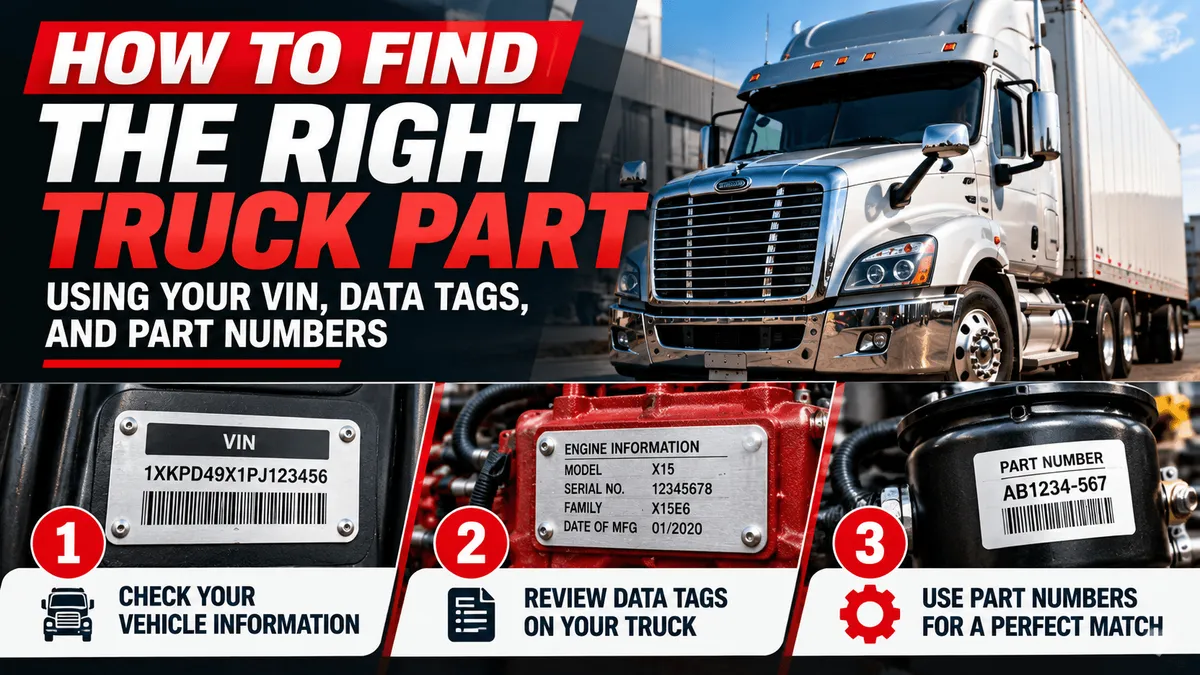
The 17-character vehicle identification number is the starting point for most fitment checks. It identifies the manufacturer and gives access to build information, and it includes a character that indicates model year.
Where to find it:
On the dash, visible through the windshield on many trucks
On the driver's door jamb label
On registration and ownership documents
On the frame or other manufacturer-specified locations
A supplier or OEM parts system can use the VIN to look up how that specific truck was built, which narrows down the correct part far more than make, model, and year alone.
For OEM parts such as our Volvo OEM and Freightliner OEM lines, the VIN is often the fastest route to a confirmed match.
3. Know the Component Tags and Data Plates
The VIN identifies the truck. Individual major components often carry their own tags, which identify exactly what was fitted. These are particularly useful because components get replaced and swapped over a truck's life.
Common places to look:
Engine data plate, usually on the engine itself, showing model and serial information
Transmission tag, identifying model and serial number
Axle tags, showing axle model, ratio, and manufacturer information
Brake component markings on drums, rotors, calipers, and chambers
Suspension tags or markings on air springs, rods, and brackets
Cab or chassis build tags listing option codes
Take clear photos of tags before you call or order. They're often hard to read once you're away from the truck, and a photo lets a supplier verify details with you.
4. Reading and Using Part Numbers
If you can read a part number off the old part, you're often most of the way there. Part numbers may appear:
Stamped or cast into the part
On a label or tag
On packaging or invoices from a previous purchase
In the truck's maintenance records
A few cautions:
Wear, paint, and dirt can obscure numbers. Clean the part and check several surfaces.
Multiple numbers can appear. A part may carry a manufacturer number, a casting number, and a date code, and these aren't interchangeable.
Numbers can be superseded. Manufacturers replace older numbers with newer ones, so an old number may point to an updated part.
A casting number isn't always a part number. Casting numbers identify a mold, and may not specify the finished part.
If you're unsure which number is the right one, send the supplier a photo and let them identify it.
5. Cross-Referencing OEM and Aftermarket Numbers
Many heavy-duty parts are available both as OEM and from aftermarket manufacturers. Aftermarket brands publish their own numbers, along with cross-reference information showing which OEM numbers they replace.
Cross-referencing lets you:
Compare options at different price points
Source a part when the OEM version is unavailable or backordered
Confirm that two parts are equivalent rather than assuming
When we supply Dayton Parts or Silverback HD components, we match them against the original specification and, where the original number is available, against its cross-reference. A good supplier should be able to explain what the part replaces and whether anything differs.
6. Measurements and Visual Checks
When numbers are missing or unreadable, measurements and visual comparison help narrow things down. They should supplement identification, not replace it.
Useful measurements depend on the part, but may include:
Overall length, width, or diameter
Bolt hole spacing and size
Port and thread sizes
Mounting dimensions
Spline counts or other interface details
Take measurements carefully and note what you measured and how. Place the old part next to the new one before installing, as a final visual check.
Measurements alone can mislead, since two parts can match in size and still differ in capacity or internal specification. Treat them as a way to rule things out.
7. Information to Have Ready When You Call a Supplier
The more you have on hand, the faster and more accurate the match. Gather:
Truck VIN
Make, model, and model year
Engine, transmission, and axle information where relevant
The part's position (front or rear, left or right, which axle)
Part numbers from the old part, if readable
Photos of the old part, its markings, and any relevant tags
Symptoms or what's being replaced, in case the underlying problem is something else
Quantity needed, including whether you want to replace in sets
When you call us at 905-564-7710 with this information, we can confirm fitment and availability quickly instead of going back and forth.
8. Common Fitment Mistakes
Ordering by make, model, and year only, ignoring mid-year changes and option variations
Assuming left and right are interchangeable when they're not
Trusting a casting number as the part number
Matching by appearance without checking specifications
Ignoring superseded numbers and ordering an outdated part
Skipping the component tag, and ordering for the truck's original axle or transmission when it's been swapped
Not confirming quantity, then discovering you need a pair or full kit
Ordering without confirming the actual failure, and replacing a part that wasn't the problem
9. When to Check Before You Install
Even with careful identification, a final check takes minutes and can prevent a bigger problem:
Compare old and new side by side before removal is finished
Check that mounting points, ports, and connections line up
Confirm any included hardware and whether additional parts are needed
Read the supplier's or manufacturer's instructions for installation specifics
Don't force a part that doesn't fit. A part that needs forcing is usually the wrong part
If something doesn't match, stop and contact the supplier before installing. Most suppliers would rather confirm fitment than process a return after an attempted install.
10. Frequently Asked Questions
Can you find a truck part by VIN? Often, yes. The VIN lets a supplier or OEM system look up how the truck was built, which narrows down the correct part. Component tags and part numbers add confirmation.
Where is the VIN on a semi truck? Commonly on the dash visible through the windshield and on the door jamb label, as well as on registration documents. Locations vary by manufacturer.
What if the part number on my old part is worn off? Send photos of the part and any tags, along with your VIN and the part's position. A supplier can often identify it from those details, or from measurements.
Is a casting number the same as a part number? Not necessarily. A casting number identifies the mold and may not specify the finished part, so confirm with the supplier.
Can I use an aftermarket part in place of an OEM part? Often, yes, if it's a proper replacement for the original specification. Ask the supplier for the cross-reference and any differences.
What information should I have before I call? Your VIN, make, model, and year, the part's position, any part numbers, and photos. Engine, transmission, and axle details help for drivetrain and brake parts.
11. Final Thoughts
Getting the right part the first time comes down to information. A VIN, component tags, a readable part number, and a few photos are usually enough for a supplier to confirm fitment, and a few minutes of preparation can save days of downtime.
Not Sure Which Part You Need?
Gill Truck Parts has supplied heavy-duty truck parts to fleets across Mississauga and the Greater Toronto Area for over 15 years. Send us your VIN and photos of the part, and we'll help you confirm the right match before you order.
📞 Call us now: 905-564-7710 📍 1295 Shawson Dr, Mississauga, ON L4W 1C4
Related reading: Heavy Duty Truck Parts in Mississauga: Local Buyer's Guide | Volvo Truck Parts Guide | Fleet Maintenance Parts in Mississauga