




Blog
Stay Informed With Expert Auto Tips & Insights
We’re dedicated to providing you with the latest automotive news, maintenance tips, and expert advice. Our blog is your go-to resource for everything from vehicle care to understanding common issues and how to prevent them.
Mastery.
Proficiency.
Creativity.
Revolution.
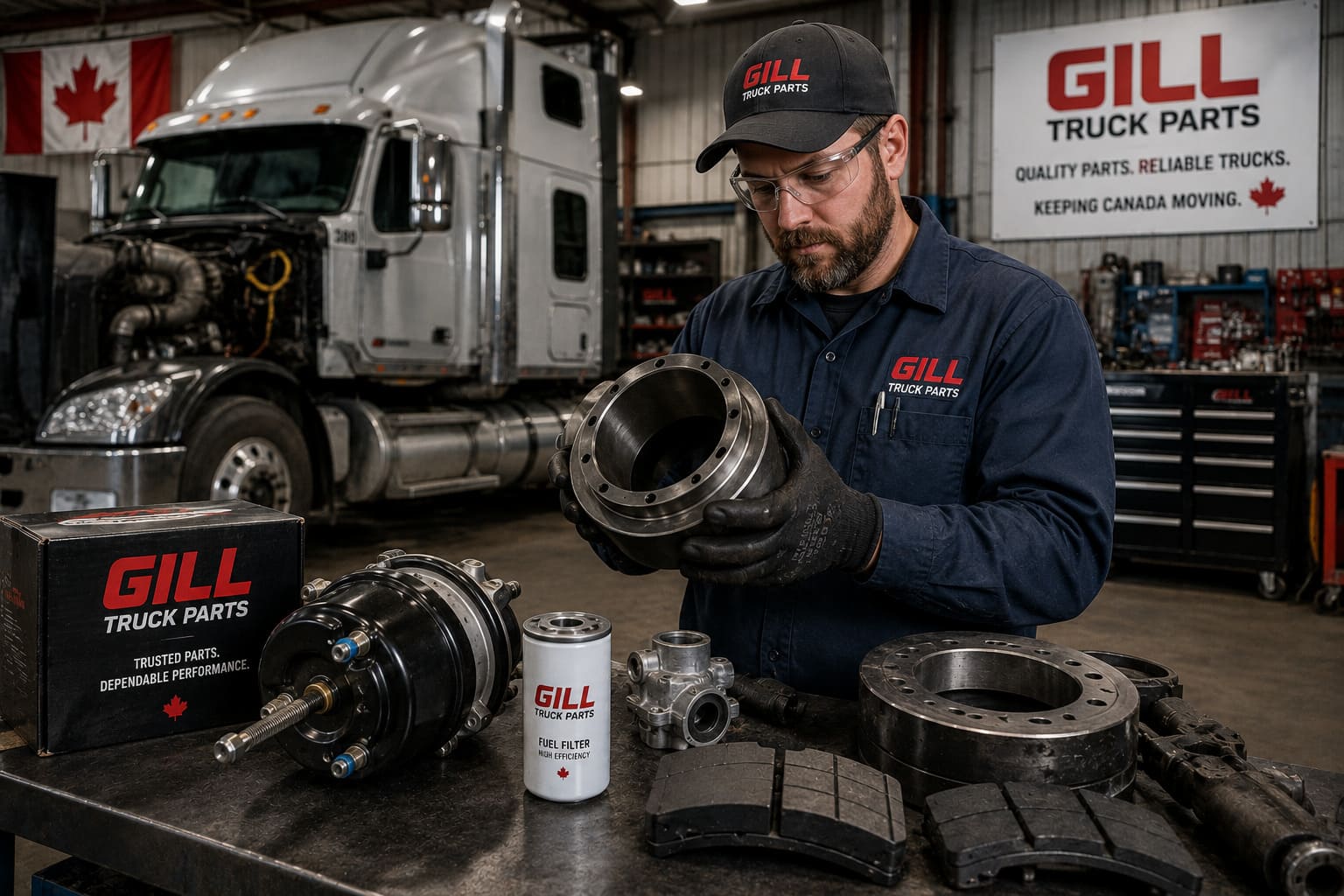
How to Choose Reliable Heavy Duty Truck Parts: A No-Nonsense Guide for Canadian Fleets
A fleet procurement manager in Alberta thought he found a deal.
An online supplier offered brake components for a Kenworth T680 at nearly $200 less than the usual price. The parts arrived fast. Everything looked fine.
Three weeks later, that same truck failed a CVIP inspection after a seized brake component damaged the wheel-end assembly. Total repair bill? Just over $6,000.
The truck sat off-road for five days.
The root problem wasn’t the mechanic.
It wasn’t the driver.
It was an uncertified part with no warranty, no traceability, and no real supplier accountability.
Buying reliable truck parts isn’t complicated. But it does require knowing what to look for, what to avoid, and who to trust.
The cheapest part on the shelf is rarely the cheapest decision you’ll ever make.
Canadian fleets are under constant pressure to reduce downtime, control repair costs, and pass increasingly strict inspection standards. According to the Canadian Trucking Alliance, trucking moves most domestic freight across Canada every single day. When trucks stop moving, revenue disappears fast.
That’s exactly why this guide exists.
Not sure where to start? Browse our full catalog of reliable truck parts - OEM and premium aftermarket, for all major Canadian fleet brands.
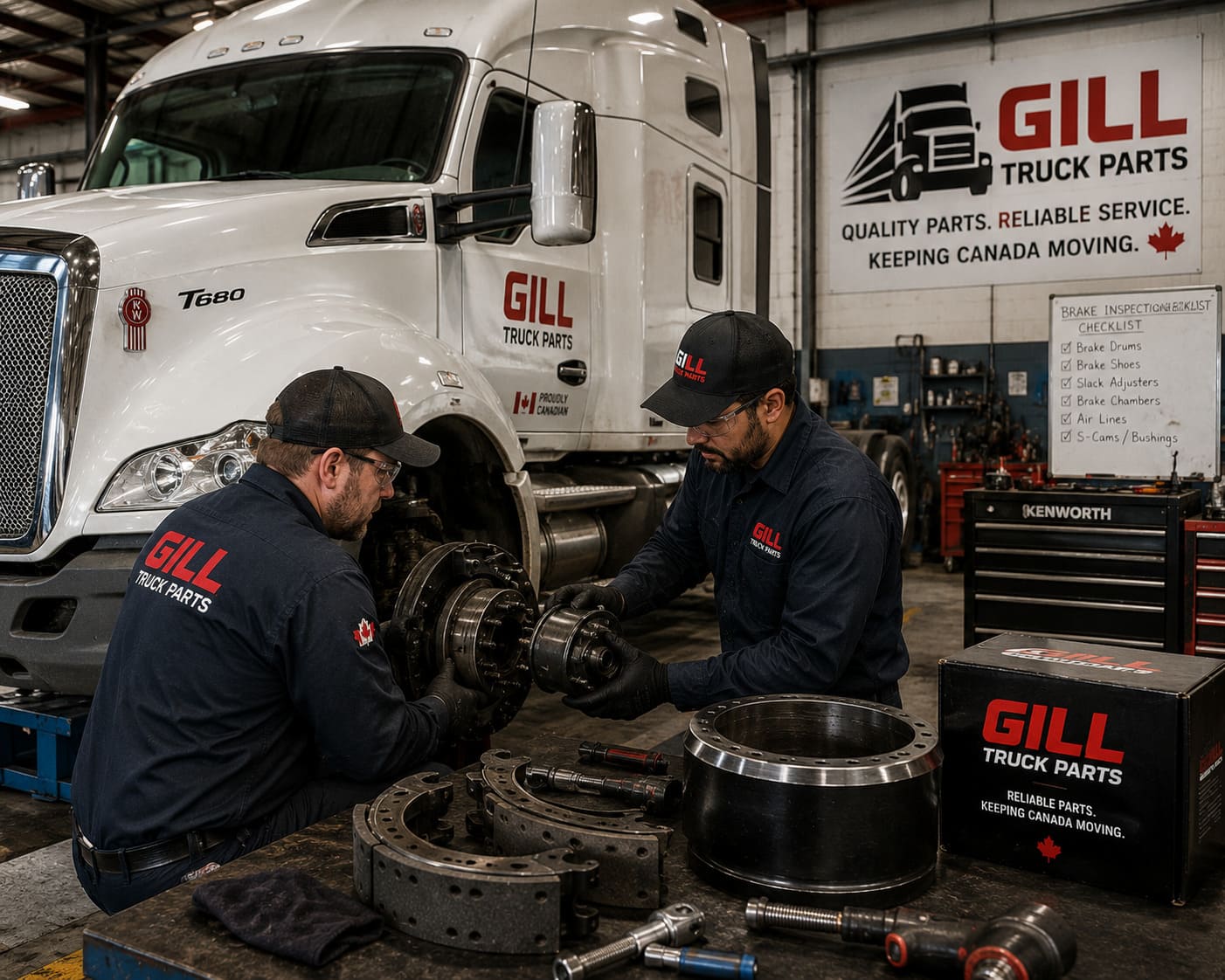
What Makes Truck Parts “Reliable”? (And Why It’s Not Just About Brand)
Reliable truck parts are components built with quality materials, tested to proper standards, matched correctly to the truck application, and backed by supplier accountability. Real reliability comes from fitment accuracy, manufacturing quality, certification, and long-term support — not just the logo stamped on the box.
A veteran mechanic in Sudbury once said something that stuck with me.
“Half the bad parts I see aren’t junk parts. They’re the wrong parts.”
He was right.
A Freightliner Cascadia and an older Columbia may look similar at a glance, but brake assemblies, steering geometry, and electronic systems can differ significantly between model years.
That’s why reliable truck parts come down to four core pillars.
1. Material and Manufacturing Quality
Cheap castings crack.
Low-grade seals fail.
Poor metallurgy destroys suspension and drivetrain components faster than most fleets realize.
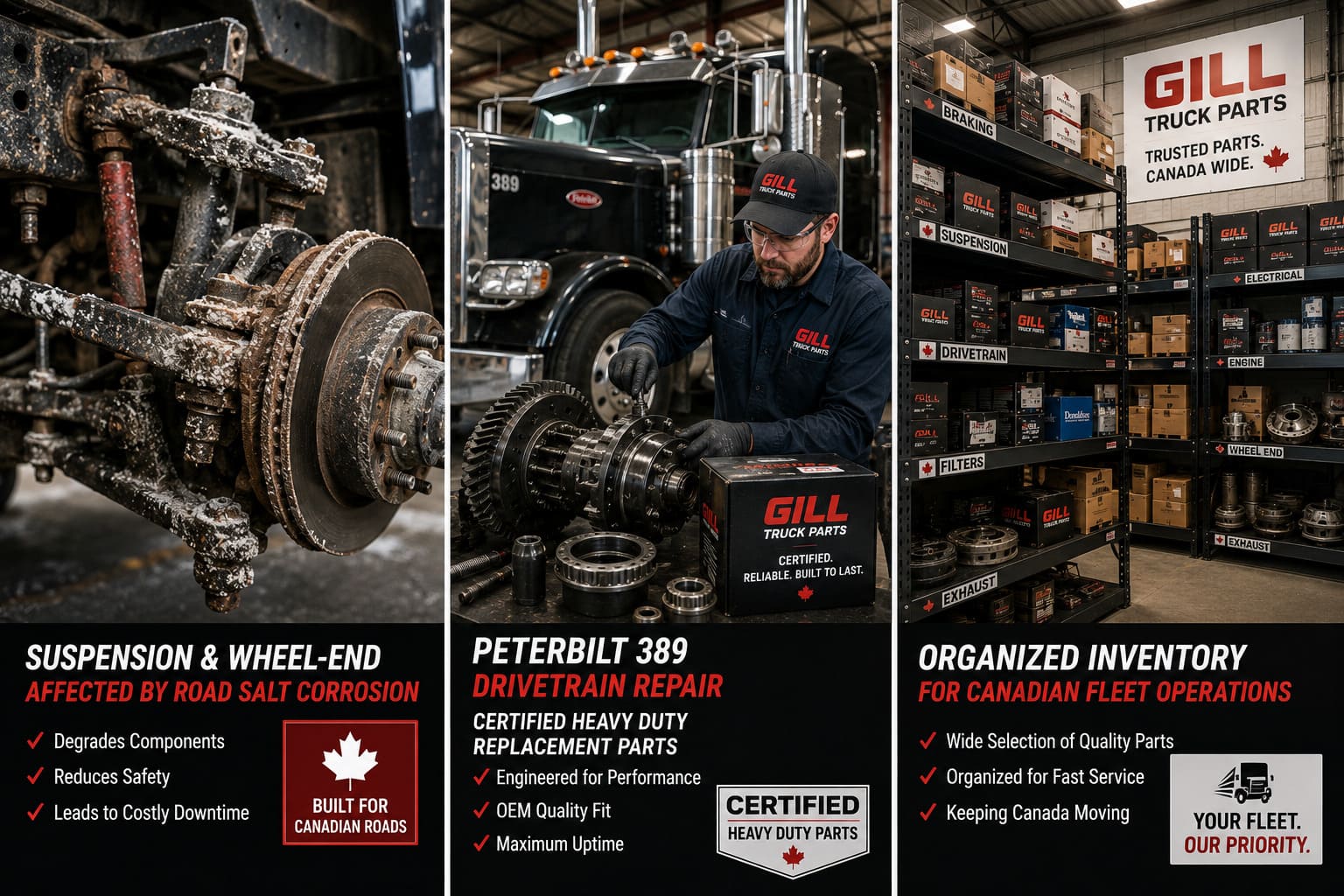
Canadian winter roads make this worse. Freeze-thaw cycles across Ontario highways hammer suspension parts constantly, while Atlantic coast salt exposure accelerates corrosion on wheel-end assemblies.
2. Correct Fit and Compatibility
Parts must match your truck’s:
VIN specifications
Engine package
Axle configuration
Model year
OEM system requirements
A PACCAR MX-powered Kenworth T680 uses a completely different parts ecosystem than a Cummins X15-equipped Peterbilt 389.
That distinction matters.
3. Certifications and Testing Standards
Reliable heavy duty replacement parts should meet recognized manufacturing and testing standards.
Look for:
ISO 9001 certification
SAE compliance
OEM-equivalent specifications
NSF-related material standards where applicable
CAN/CGSB references for commercial applications
For fleets operating in Quebec or Ontario with strict CVIP requirements, our upcoming article on passing your commercial vehicle inspection with the right parts covers exactly what inspectors look for.
4. Supplier Accountability
If a supplier disappears after the sale, you’re carrying all the risk.
A reliable commercial truck parts supplier provides:
Warranty support
Product traceability
Technical guidance
Return protection
Documentation when needed
A part can come from a reputable brand and still be wrong for your application. Reliability is fitment + quality + support - all three.
Counterfeit and grey-market truck parts are also becoming a growing issue across Canada. Some fake components now closely mimic OEM packaging, especially for filters, bearings, and brake hardware.
That’s dangerous.
7 Criteria to Evaluate Before You Buy Truck Parts
A fleet manager outside Winnipeg once ordered suspension components online based only on price.
Wrong move.
The bushings failed before 60,000 km during Prairie winter operations. The labor cost to replace them a second time erased every dollar “saved” on the initial purchase.
Here’s the checklist smart fleet buyers actually use.
1. Part Compatibility
Does the part match your truck’s exact VIN, engine package, model year, and configuration?
A Freightliner Cascadia air system component may not interchange with older Freightliner Columbia setups.
Never assume.
2. Certification and Standards
Look for ISO-certified manufacturers and suppliers that confirm OEM-equivalent specifications.
Reliable suppliers should understand SAE and FMCSA-related compliance expectations.
3. Supplier Reputation
How long has the company been serving heavy-duty fleets?
Do they specialize in commercial truck parts or just resell general inventory online?
Experience matters.
4. Warranty Coverage
Mechanical truck maintenance parts should carry real warranty protection.
Brake components should offer at least a 12-month or mileage-based guarantee.
No warranty usually means no confidence.
5. Parts Traceability
Ask where the part was manufactured.
If the supplier can’t answer basic sourcing questions, that’s a problem.
Reliable truck parts should always have documentation trails.
6. Technical Support
Can the supplier explain application-specific differences?
Or are they simply reading product descriptions off a screen?
A knowledgeable supplier can save you thousands in avoided fitment mistakes.
7. Inventory Depth
A serious truck parts supplier Canada operation carries inventory across multiple truck brands.
That includes:
Freightliner parts
Kenworth parts
Peterbilt parts
Volvo truck parts
International truck components
Most fleet buyers only evaluate two or three of these factors.
Usually price, shipping speed, and availability.
That’s where expensive mistakes happen.
A cheap drivetrain part with poor metallurgy might survive local city work, then fail halfway through a BC mountain route pulling loaded weight. Suddenly the savings disappear into towing, labor, missed deliveries, and roadside downtime.
Reliable truck parts reduce long-term operating costs because they prevent repeat failures, emergency labor, and unplanned downtime.
Want expert help matching the right parts to your specific truck? Talk to a Gill Truck Parts specialist - we’ll walk you through compatibility, certification, and the best value for your application.
Red Flags - Warning Signs of Unreliable Truck Parts Suppliers
Reliable suppliers don’t hide information.
Bad suppliers usually do.
Watch for these warning signs before placing any fleet parts purchasing order:
No physical Canadian business address
Prices 50–70% below market value without explanation
No warranty documentation
Vague “all sales final” language
Unable to verify manufacturer or country of origin
No returns or exchange process
Staff cannot explain fitment differences between truck models
No customer reviews from real fleets or diesel mechanics
A procurement manager in Ontario once bought counterfeit filters marketed as OEM-equivalent replacements for a Volvo VNL 860 fleet.
The packaging looked legitimate.
The filter media wasn’t.
Several trucks experienced premature contamination issues within months.
The cleanup cost more than $11,000.
In the heavy-duty parts market, if a deal looks too good to be true — it’s costing someone somewhere. And that someone usually ends up being you, six months later.
Which Truck Parts Need the Highest Reliability Standards?
The most reliability-critical truck parts are safety systems, drivetrain components, and electronic control systems. Failures in these areas create the highest risk for roadside breakdowns, failed inspections, expensive repairs, and driver safety concerns. These are the components where cutting corners usually becomes very expensive.
Not every part on your truck needs top-tier OEM pricing.
But some absolutely demand higher standards.
Tier 1 - Safety-Critical Components
Zero compromise here.
This category includes:
Air brake components
Steering assemblies
Wheel-end components
Suspension kingpins
Failures in these systems create immediate safety risks and potential DOT or CVIP violations.
A failed wheel-end bearing on a Trans-Canada route during winter conditions can destroy hubs, brakes, seals, and surrounding suspension hardware fast.
Tier 2 - Drivetrain and Engine Components
High reliability required.
This includes:
Fuel injectors
Turbochargers
Transmission components
Clutch assemblies
Engine sensors
A failed turbocharger on a Volvo VNL 860 can easily create repair bills exceeding $10,000 once downtime and towing are included.
Tier 3 - Wear Parts
This category offers more flexibility.
Examples include:
Filters
Belts
Brake shoes
Lighting components
Premium aftermarket parts are often completely reliable in these applications.
A BC logging fleet that standardized sourcing for Tier 1 brake and wheel-end parts reportedly reduced brake-related failures by nearly 40% over an 18-month period. That outcome is becoming increasingly common among fleets focused on preventive maintenance.
The higher the consequence of failure, the less sense it makes to gamble on unknown parts quality.
How to Verify That Heavy Duty Truck Parts Are Reliable Before Purchasing
A mechanic in Regina once spent two full days troubleshooting a transmission issue that turned out to be caused by an incorrect sensor sold under the wrong part number.
The truck didn’t need repairs.
It needed the right part.
Here’s the verification process experienced fleet buyers follow.
1. Cross-Reference the Part Number
Always compare the part number against OEM documentation, service manuals, or VIN-specific records.
Never rely solely on visual similarity.
2. Ask About Manufacturer Origin
Where was the part made?
Who manufactured it?
Reliable suppliers should answer immediately.
3. Verify Authorized Distribution
Ask whether the supplier is authorized to distribute the brands they carry.
That reduces counterfeit risk significantly.
4. Request Warranty Documentation
Get warranty coverage in writing before purchasing.
Especially for brake, suspension, drivetrain, and engine components.
5. Ask About Certification or Testing Data
For critical components, request testing information or certification references.
Legitimate manufacturers usually provide this without hesitation.
6. Read Fleet-Specific Reviews
General consumer reviews don’t tell the full story.
Look specifically for feedback from commercial fleets, diesel mechanics, and owner-operators.
7. Test Before Bulk Purchasing
If possible, buy one unit before rolling out large-volume fleet orders.
This protects your operation from large-scale compatibility issues.
Reliable truck parts purchasing is really about reducing risk before the truck ever leaves the yard.
How a Trusted Parts Supplier Protects Your Fleet and Your Bottom Line
According to the Canadian Trucking Alliance, unplanned downtime can cost fleets anywhere from $1,500 to $5,000 per truck per day.
That’s before customer penalties, missed appointments, and dispatch disruptions.
The real value of a trusted supplier isn’t just inventory.
It’s support.
A good supplier helps your fleet:
Choose the right OEM or aftermarket application
Reduce repeat repairs
Source parts faster during breakdowns
Access fleet pricing and credit terms
Get accountability when problems happen
That’s exactly the kind of partnership Gill Truck Parts was built to provide.
As a heavy duty truck parts supplier serving Canadian fleets, Gill carries OEM and premium aftermarket parts for Freightliner, Kenworth, Peterbilt, Volvo, and International — backed by knowledgeable staff who can help you make the right call for your specific truck, budget, and operating conditions.
If you’re specifically running Freightliner equipment, our detailed breakdown of Freightliner Cascadia parts and service intervals walks through every major component and what to watch for.
Fast shipping matters too.
Especially when a truck is stranded outside Thunder Bay in February.
The right supplier doesn’t just sell parts — they reduce downtime, protect your maintenance budget, and keep your fleet moving.
Shop Reliable Truck Parts at Gill | Set Up a Fleet Account | Get Fast Shipping Across Canada
Reliable Truck Parts + Preventive Maintenance = Maximum Fleet Uptime
The best preventive maintenance program in the world still fails if low-quality parts are going into the truck.
That’s the reality.
Reliable truck parts reduce stress on adjacent systems.
A properly manufactured wheel seal protects bearings longer. Quality suspension components reduce uneven tire wear. Better brake hardware lowers strain on surrounding assemblies.
Everything works together.
Fleet managers who combine proactive maintenance schedules with reliable truck maintenance parts consistently outperform reactive operations focused only on emergency repairs.
Keeping common wear components onsite also matters.
Many successful Canadian fleets keep emergency inventory for:
Filters
Brake shoes
Belts
Wheel seals
Lighting components
Air system fittings
That alone can reduce average repair time significantly.
Prairie winter operations and Ontario freeze-thaw conditions are brutal on suspension and wheel-end systems. Waiting until parts fail almost always costs more.
For a deeper look at building a preventive maintenance parts program, see our upcoming guide on preventive maintenance parts planning for Canadian fleets.
Reliable truck parts aren’t just maintenance expenses, they’re uptime investments.
Conclusion
Choosing reliable truck parts comes down to three things: compatibility, certification, and supplier trust.
The fleets that consistently reduce downtime are the ones that verify fitment carefully, buy from accountable suppliers, and avoid gambling on unknown parts quality. Whether you’re maintaining a Freightliner Cascadia, Kenworth T680, Peterbilt 389, or Volvo VNL 860, the right parts strategy protects both your trucks and your operating budget.
Reliable truck parts aren’t a luxury - they’re the foundation of a profitable, safe, and road-ready fleet.
Looking for reliable truck parts for your fleet? Contact Gill Truck Parts for expert guidance, fast shipping, and parts you can trust — for every truck in your lineup.
Shop Reliable Truck Parts at Gill | Set Up a Fleet Account | Get Fast Shipping Across Canada
FAQ SECTION
Q: What makes heavy duty truck parts reliable?
A: Reliable heavy duty truck parts combine proper manufacturing quality, correct fitment, certification standards, and supplier accountability. A part that fits your exact truck specifications, carries warranty support, and meets recognized standards is far less likely to fail early or create expensive downtime problems.
Q: How do I know if a truck parts supplier is trustworthy?
A: Look for suppliers with a Canadian business presence, real fleet experience, technical support staff, clear warranty policies, and strong customer reviews from commercial operators. Reliable suppliers should also explain fitment differences, manufacturer origin, and application details without hesitation.
Q: Are cheaper truck parts worth buying?
A: Sometimes — but only if they come from reputable manufacturers and meet OEM-equivalent standards. Premium aftermarket wear parts like filters or brake shoes can offer excellent value. Extremely cheap parts with no certification or traceability usually create bigger repair costs later.
Q: What truck parts should never be purchased from unknown suppliers?
A: Fleets should avoid buying unknown brake components, steering parts, wheel-end assemblies, injectors, turbochargers, and electronic sensors from unverified suppliers. Failures in these systems can create safety risks, roadside breakdowns, failed inspections, and major repair bills.
Q: How can I verify truck part quality before buying?
A: Cross-reference part numbers with OEM records, request warranty documentation, verify manufacturer information, and ask about certifications or testing standards. Reading reviews from commercial fleets and diesel mechanics also helps identify suppliers with proven product quality.
Q: How does part quality affect fleet downtime?
A: Poor-quality parts fail sooner, create repeat repairs, and increase roadside breakdown risk. Reliable truck parts last longer, improve preventive maintenance effectiveness, and reduce labor hours spent replacing failed components. That directly improves fleet uptime and operating efficiency.
Q: Where can I buy reliable heavy duty truck parts in Canada?
A: Reputable Canadian truck parts suppliers with fleet experience are usually the safest choice. Look for suppliers carrying OEM and premium aftermarket inventory for Freightliner, Kenworth, Peterbilt, Volvo, and International trucks, backed by warranty support and technical expertise.
Need Reliable Truck Parts? Get Expert Help Fast
Need dependable heavy duty truck parts in Mississauga or the GTA? Our experts help you quickly find the right components for your truck, reducing downtime and keeping your fleet running safely and efficiently.
Reliable distributor of heavy-duty truck parts in Mississauga, proudly serving the 401 Dixie corridor and the Greater Toronto Area.
Our Partner
Service Area
Contact us
1295 Shawson Dr, Mississauga, ON L4W 1C4

© 2026 Gill Truck Parts. All rights reserved. Powered by Xalovo AI