




Blog
Stay Informed With Expert Auto Tips & Insights
We’re dedicated to providing you with the latest automotive news, maintenance tips, and expert advice. Our blog is your go-to resource for everything from vehicle care to understanding common issues and how to prevent them.
Mastery.
Proficiency.
Creativity.
Revolution.
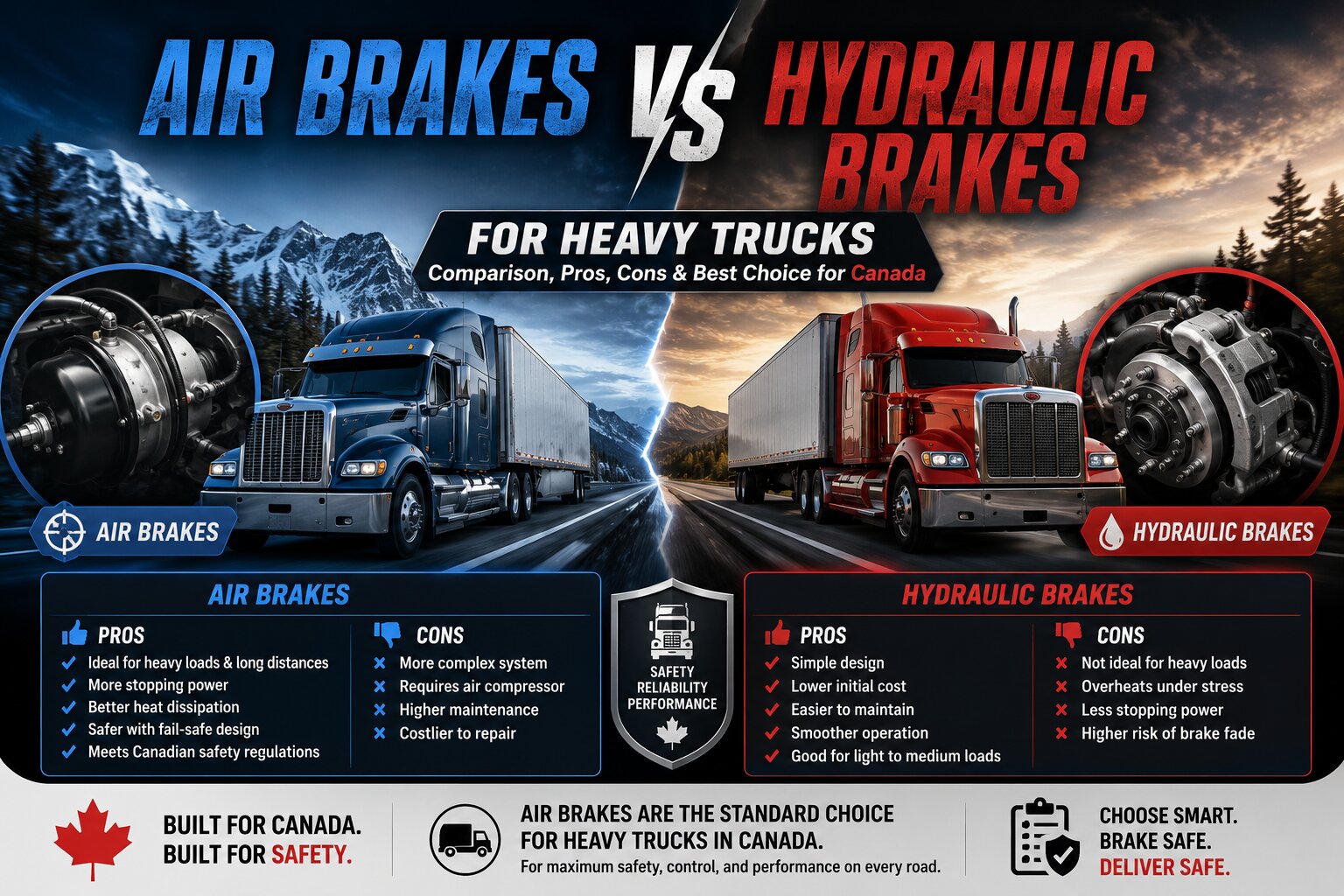
Air Brakes vs Hydraulic Brakes for Heavy Trucks
Braking systems are one of the most important safety components in any commercial vehicle. Whether you operate long-haul semi trucks, dump trucks, delivery fleets, or construction vehicles in Canada, choosing the right braking system directly impacts safety, performance, maintenance costs, and reliability.
Two of the most common braking systems used in heavy duty vehicles are air brakes and hydraulic brakes. While both systems perform the same basic function, they operate differently and are designed for different types of trucks and driving conditions.
For fleet owners, truck drivers, and owner-operators, understanding the differences between air brakes and hydraulic brakes can help improve vehicle performance, reduce downtime, and ensure safer operations on Canadian roads.
In this guide, we will compare air brakes vs hydraulic brakes for heavy trucks, explain how each system works, highlight their advantages and disadvantages, and help you determine which braking system is best for your commercial vehicles.
Table of Contents
What Are Air Brakes?
What Are Hydraulic Brakes?
How Air Brakes Work
How Hydraulic Brakes Work
Key Differences Between Air and Hydraulic Brakes
Advantages of Air Brakes
Advantages of Hydraulic Brakes
Disadvantages of Air Brakes
Disadvantages of Hydraulic Brakes
Which Brake System Is Better for Heavy Trucks?
Canadian Weather and Brake Performance
Brake Maintenance Tips for Commercial Fleets
Common Brake Problems in Heavy Trucks
Air Brakes vs Hydraulic Brakes Comparison Table
People Also Ask
Final Thoughts
What Are Air Brakes?
Air brakes are braking systems powered by compressed air instead of brake fluid.
They are commonly used in:
Semi trucks
Tractor-trailers
Buses
Construction vehicles
Commercial fleet trucks
Air brakes are widely preferred for heavy duty applications because they provide powerful and reliable stopping performance under heavy loads.
What Are Hydraulic Brakes?
Hydraulic brakes use brake fluid pressure to transfer force from the brake pedal to the brake components.
They are commonly found in:
Pickup trucks
Light commercial vehicles
Delivery vans
Medium-duty trucks
Hydraulic brake systems are simpler and more compact than air brake systems.
How Air Brakes Work
Air brake systems rely on compressed air generated by an onboard air compressor.
Main Air Brake Components
Air Compressor
Supplies compressed air to the system.
Air Tanks
Store compressed air for braking operations.
Brake Chambers
Convert compressed air into mechanical force.
Slack Adjusters
Control brake shoe movement.
Brake Drums or Disc Brakes
Create friction to slow the vehicle.
Air Brake Process
The driver presses the brake pedal.
Compressed air flows through brake lines.
Brake chambers activate.
Brake shoes or pads press against drums or rotors.
The truck slows down safely.
Air brakes are highly effective for vehicles carrying heavy cargo loads.
How Hydraulic Brakes Work
Hydraulic brake systems use brake fluid to transfer braking force.
Main Hydraulic Brake Components
Master Cylinder
Creates hydraulic pressure.
Brake Lines
Carry brake fluid through the system.
Brake Calipers
Apply pressure to brake pads.
Brake Pads and Rotors
Create friction to stop the truck.
Hydraulic Brake Process
The driver presses the brake pedal.
Hydraulic fluid pressure increases.
Brake calipers activate.
Brake pads clamp onto rotors.
The vehicle slows down.
Hydraulic brakes are effective for lighter vehicles and medium-duty trucks.
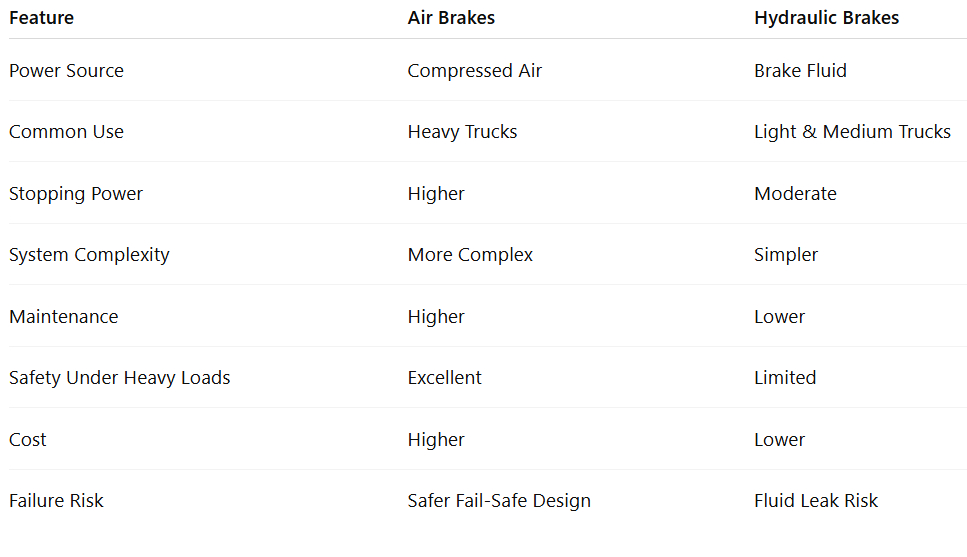
Key Differences Between Air and Hydraulic Brakes
Advantages of Air Brakes
Air brakes are widely used in commercial trucking because of their strong performance.
1. Better Stopping Power
Air brakes generate strong braking force for:
Fully loaded trailers
Long-haul trucks
Construction equipment
This makes them ideal for heavy commercial vehicles.
2. Improved Safety
Air brake systems are designed with fail-safe features.
If air pressure drops too low:
Emergency brakes activate automatically
Drivers receive warning alerts
This improves safety during system failures.
3. Better Heat Resistance
Heavy trucks generate enormous braking heat.
Air brakes handle heat more effectively than hydraulic systems.
4. Reliable for Long-Haul Operations
Air brakes perform well during:
Mountain driving
Highway hauling
Harsh weather conditions
This makes them ideal for Canadian trucking operations.
Advantages of Hydraulic Brakes
Hydraulic brakes also offer important benefits.
1. Lower Maintenance Costs
Hydraulic systems contain fewer components and are easier to service.
2. Faster Brake Response
Hydraulic brakes often respond more quickly in lighter vehicles.
3. Lower Initial Cost
Hydraulic brake systems are generally more affordable to install and repair.
4. Compact System Design
Hydraulic systems require less space and are suitable for smaller commercial trucks.
Disadvantages of Air Brakes
While air brakes are highly effective, they also have some drawbacks.
1. More Complex Maintenance
Air brake systems include:
Compressors
Air tanks
Valves
Brake chambers
These components require regular inspections.
2. Higher Repair Costs
Air brake repairs can be more expensive than hydraulic brake repairs.
3. Moisture Problems
Condensation inside air tanks can create moisture buildup.
Without proper maintenance, this may lead to:
Corrosion
Frozen brake lines during winter
Disadvantages of Hydraulic Brakes
Hydraulic systems also have limitations for heavy-duty applications.
1. Reduced Performance Under Heavy Loads
Hydraulic brakes may struggle under extreme commercial loads.
2. Brake Fluid Leaks
Fluid leaks reduce braking efficiency and create safety risks.
3. Heat Sensitivity
Excessive heat can reduce hydraulic braking performance.
Which Brake System Is Better for Heavy Trucks?
For most heavy duty trucks, air brakes are considered the superior choice.
Air Brakes Are Best For:
Semi trucks
Long-haul transportation
Heavy commercial fleets
Construction vehicles
Hydraulic Brakes Are Better For:
Light-duty commercial vehicles
Smaller delivery trucks
Medium-duty applications
The right system depends on:
Vehicle weight
Cargo loads
Driving conditions
Maintenance requirements
Canadian Weather and Brake Performance
Canadian weather conditions create additional braking challenges.
Winter Conditions
Snow and ice increase stopping distances.
Air brake systems provide stronger braking performance for heavy trucks operating in:
Ontario
Alberta
British Columbia
Quebec
Mountain Driving
Heavy trucks traveling through mountainous regions require reliable braking systems capable of handling continuous downhill braking.
Air brakes are better suited for these demanding conditions.
Brake Maintenance Tips for Commercial Fleets
Proper maintenance is essential for both braking systems.
Air Brake Maintenance Tips
Drain Air Tanks Regularly
Removes moisture buildup.
Inspect Air Lines
Check for leaks or cracks.
Monitor Air Pressure
Ensure proper compressor operation.
Hydraulic Brake Maintenance Tips
Check Brake Fluid Levels
Low fluid affects braking performance.
Inspect Brake Lines
Look for leaks or corrosion.
Replace Worn Brake Pads
Prevents rotor damage.
Common Brake Problems in Heavy Trucks
Fleet managers should monitor for warning signs such as:
Grinding noises
Brake vibrations
Low air pressure warnings
Brake fluid leaks
Reduced stopping power
Pulling while braking
Early inspections help prevent expensive repairs.
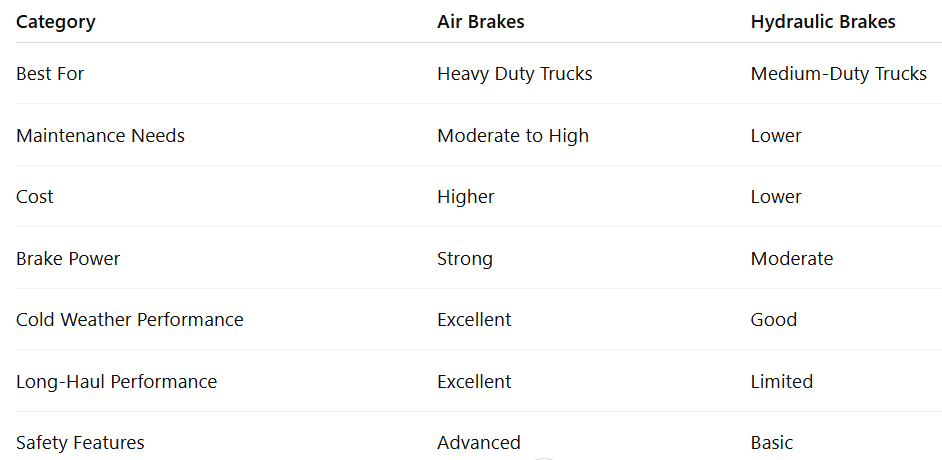
Air Brakes vs Hydraulic Brakes Comparison Table
Expert Insights for Fleet Owners
Industry professionals recommend:
Routine brake inspections
Driver brake safety training
Preventive maintenance programs
High-quality replacement parts
Reliable brake systems improve:
Safety
Fuel efficiency
Fleet uptime
Operational reliability
People Also Ask
Are air brakes better than hydraulic brakes?
Air brakes are generally better for heavy trucks because they provide stronger stopping power and improved safety.
Why do semi trucks use air brakes?
Semi trucks use air brakes because they perform better under heavy loads and long-haul conditions.
Can hydraulic brakes handle heavy loads?
Hydraulic brakes can handle moderate commercial loads but are less effective for large heavy-duty trucks.
Do air brakes require more maintenance?
Yes. Air brake systems have more components and require regular inspections and servicing.
Why Quality Brake Parts Matter
Reliable brake components help:
Improve stopping performance
Reduce downtime
Increase safety
Extend brake system lifespan
Choosing high-quality truck brake parts is critical for commercial fleet operations in Canada.
Final Thoughts
Understanding the differences between air brakes and hydraulic brakes helps fleet owners choose the right braking system for their vehicles.
While hydraulic brakes are effective for smaller trucks and lighter applications, air brakes remain the preferred choice for heavy duty trucks due to their stronger stopping power, fail-safe design, and superior performance under heavy loads.
Regular maintenance, proper inspections, and quality replacement parts are essential for keeping braking systems safe and reliable.
For dependable heavy duty truck brake parts and expert support in Canada, visit Gill Truck Parts today.
FAQ Section
What is the biggest advantage of air brakes?
Air brakes provide strong stopping power and safer braking for heavy commercial vehicles.
Are hydraulic brakes cheaper to maintain?
Yes. Hydraulic brake systems are generally less expensive to maintain than air brake systems.
Why are air brakes safer for heavy trucks?
Air brakes use fail-safe mechanisms that activate emergency braking if pressure is lost.
Can air brakes freeze during winter?
Moisture buildup inside air systems can freeze without proper maintenance.
Which brake system lasts longer?
Both systems can last a long time with proper maintenance and quality brake components.
Need Reliable Truck Parts? Get Expert Help Fast
Need dependable heavy duty truck parts in Mississauga or the GTA? Our experts help you quickly find the right components for your truck, reducing downtime and keeping your fleet running safely and efficiently.
Reliable distributor of heavy-duty truck parts in Mississauga, proudly serving the 401 Dixie corridor and the Greater Toronto Area.
Our Partner
Service Area
Contact us
1295 Shawson Dr, Mississauga, ON L4W 1C4

© 2026 Gill Truck Parts. All rights reserved. Powered by Xalovo AI